
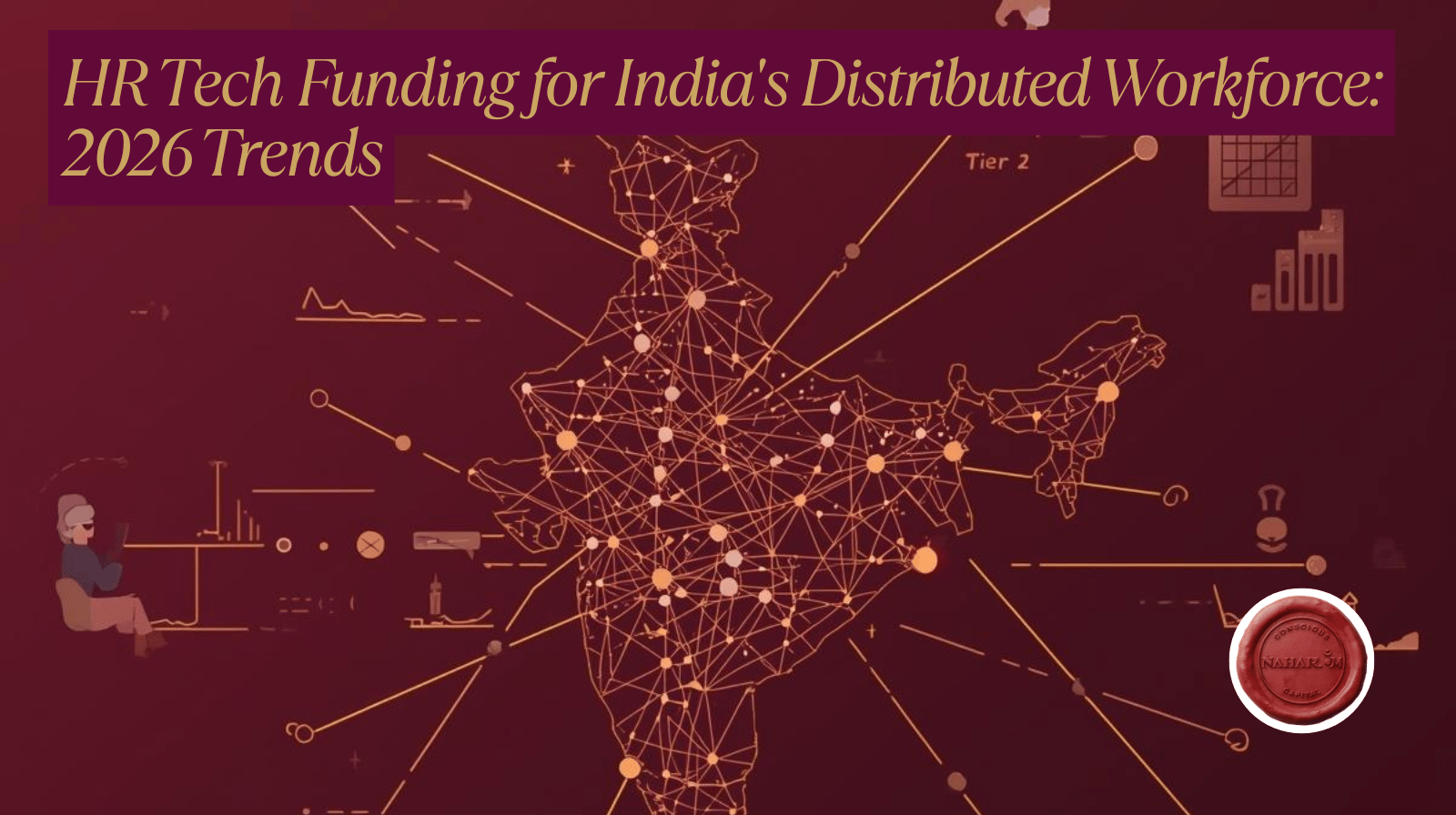
India’s workforce is no longer confined to office towers in Bengaluru, Gurgaon, or Mumbai. By 2026, distributed workforces—spanning Tier 1, Tier 2, and even rural regions—will become the norm across IT, fintech, startups, and traditional enterprises – According to the Future of Jobs Report by the World Economic Forum
This shift is reshaping how Indian companies hire talent, manage payroll and compliance, track performance, support employee well-being, and enable remote collaboration. As a result, HR tech funding in India is entering a new growth phase, with investors betting heavily on platforms that support remote-first and hybrid work models.
This guide explores key HR tech funding trends in India for 2026, distributed workforce challenges and solutions, where VCs are investing, AI-driven HR platforms, compliance and payroll innovations, and startup opportunities for Indian founders.
What Is HR Tech?
HR tech refers to software and digital platforms that help companies manage hiring and recruitment, payroll and compliance, performance management, learning and development, employee engagement, and workforce analytics. In India, HR tech increasingly focuses on scalability, compliance, and distributed workforce management.
What Is a Distributed Workforce?
A distributed workforce includes employees who work remotely from home, from co-working spaces, across multiple cities or states, and in hybrid models. India’s distributed workforce includes IT and SaaS professionals, gig workers, customer support teams, sales and field staff, and startups with pan-India teams.
Why Distributed Workforce Trends Matter in India
Key Drivers
The shift toward distributed work is driven by access to talent beyond metros, cost optimization, employee flexibility demands, digital-first business models, and gig economy growth. By 2026, over 60% of Indian white-collar workers are expected to operate in hybrid or remote setups.
This transformation creates both opportunities and challenges. Companies gain access to deeper talent pools across the country while facing new complexities in team cohesion, productivity tracking, and regulatory compliance across different states.
HR Tech Funding India 2026: Market Overview
Current Market Size
India’s HR tech market is projected to cross $3–4 billion by 2026, representing significant growth from current levels. This growth aligns with projections from NASSCOM’s Indian tech industry reports. This expansion reflects the critical role HR technology plays in enabling distributed work at scale.
Key Growth Areas
Investment is concentrated in AI-driven recruitment platforms, payroll automation systems, compliance management tools, remote productivity solutions, and employee experience platforms. These categories address the most pressing pain points for Indian businesses managing geographically dispersed teams.
What Are the Top HR Tech Funding Trends in 2026?
The top HR tech funding trends in India for 2026 include AI-powered recruitment, compliance automation, remote workforce management platforms, employee wellness tech, and data-driven performance analytics. Each of these areas solves critical problems for businesses navigating the distributed work revolution.
HR Tech Funding: 2026 vs Today
| Area | 2024 | 2026 (Projected) |
| AI in Hiring | Moderate | High |
| Compliance Automation | Growing | Essential |
| Remote HR Tools | Basic | Advanced |
| Employee Wellness | Optional | Core |
| Workforce Analytics | Emerging | Standard |
This evolution reflects how quickly the market is maturing, with yesterday’s nice-to-have features becoming tomorrow’s essential infrastructure.
Why Investors Are Bullish on HR Tech in India
Key Reasons
Investors see HR tech as mission-critical infrastructure for Indian businesses due to India’s massive workforce, ongoing digital transformation, complex compliance needs, the rise of remote work, and SaaS scalability potential. The combination of a large addressable market and genuine pain points makes this sector particularly attractive.
The regulatory complexity alone—with labor laws varying by state and employment type—creates significant opportunities for platforms that can automate compliance and reduce risk for employers.
High-Impact HR Tech Categories for 2026
1. AI-Powered Recruitment
AI tools will dominate resume screening, candidate matching, bias reduction, and skill assessment. Platforms leveraging AI-driven applicant tracking systems are attracting strong VC interest as they promise to dramatically reduce time-to-hire while improving candidate quality.
The technology has matured beyond simple keyword matching to understand context, evaluate soft skills through conversational AI, and predict candidate success based on historical data patterns.
2. Payroll & Compliance Automation
India’s labor laws are complex and state-specific. HR tech platforms are now offering automated statutory compliance, PF/ESI/GST management, labor code alignment, and contractor compliance solutions.
This category is particularly attractive to investors because it addresses a universal pain point with high switching costs once implemented. Companies that successfully navigate multi-state compliance create significant value and customer stickiness.
3. Remote Work Management Tools
By 2026, companies will need sophisticated attendance tracking, remote performance metrics, digital onboarding systems, and virtual collaboration tools that go beyond basic video conferencing.
The focus is shifting from surveillance-based monitoring to outcome-based performance measurement, helping managers assess productivity without invasive tracking that damages employee trust.
4. Employee Experience Platforms
HR tech is shifting from administration to experience. Key features include engagement surveys, mental health tools, feedback systems, and career planning capabilities that help retain talent in competitive markets.
These platforms recognize that in a distributed environment, deliberate investment in employee experience becomes critical to preventing isolation and maintaining company culture.
5. Workforce Analytics & AI
Data-driven HR will become the norm with capabilities for attrition prediction, productivity insights, and skill gap analysis. Forward-looking companies are using these tools to make proactive decisions rather than reactive interventions.
The most sophisticated platforms combine multiple data sources—performance reviews, communication patterns, project outcomes—to provide holistic views of organizational health.
Key HR Tech Funding Trends in India (2026 Focus)
Trend 1: AI-First HR Platforms
Investors prefer AI-native products with predictive analytics and smart automation built into the core architecture, not just added as features. This reflects recognition that AI capabilities will be table stakes, not differentiators.
Trend 2: Compliance-as-a-Service
India’s evolving labor codes will drive demand for automated compliance tools with real-time regulatory updates. As regulations become more complex, the value of automation increases exponentially.
Trend 3: Tier 2 & 3 Workforce Enablement
HR tech will expand beyond metros to support regional hiring, vernacular tools, and remote onboarding for talent in smaller cities. This geographic expansion represents massive untapped market potential.
Trend 4: Gig & Contract Worker Platforms
Gig workforce management tools will see major funding as the line between full-time employees and contractors continues to blur. Platforms that elegantly handle mixed workforce types will capture significant market share.
Startup Examples in Indian HR Tech
1. Darwinbox
Enterprise HR SaaS platform with strong global presence, demonstrating that Indian-built solutions can compete worldwide.
2. Keka
Payroll and HR automation focused on SMBs, filling a critical gap for smaller companies that need enterprise-grade tools at accessible price points.
3. RazorpayX Payroll
Fintech and HR integration, showing how adjacent industries can create powerful combined solutions.
4. HireSure.ai
AI-based recruitment tools representing the new generation of intelligent hiring platforms.
HR Tech Funding Sources in India
| Source | Focus |
| Venture Capital | Scalable SaaS |
| Corporate VCs | Enterprise tools |
| Angel Investors | Early-stage HR tech |
| Global Funds | AI platforms |
| Government | Digital skilling |
Each funding source has different priorities and investment theses, requiring founders to carefully match their business model to the right investor profile.
Challenges in HR Tech for Distributed Workforce
| Challenge | Solution |
| Compliance complexity | Automation |
| Engagement gaps | EX platforms |
| Data security | Cloud security |
| Performance tracking | AI analytics |
| Culture building | Virtual tools |
These challenges represent both obstacles and opportunities. Startups that effectively address these pain points will capture disproportionate value.
How HR Tech Supports Distributed Teams
Core Features
Cloud-based access ensures teams can work from anywhere, while real-time reporting keeps leadership informed. Digital onboarding creates consistent employee experiences regardless of location, and remote payroll handles the complexity of multi-state operations. Virtual feedback mechanisms maintain communication loops that might otherwise break down in distributed settings.
The best platforms make distributed work feel seamless, reducing the cognitive load on both managers and employees.
Step-by-Step: Choosing HR Tech for 2026
- Identify your workforce model—fully remote, hybrid, or flexible
- Assess compliance needs based on your geographic footprint
- Prioritize automation opportunities with highest ROI
- Evaluate AI features for quality and ethical implementation
- Check data security and privacy protections
- Ensure scalability as your workforce grows
This systematic approach helps avoid costly mistakes and ensures the selected platform will serve long-term needs.
HR Tech ROI Metrics
| Metric | Impact |
| Hiring time | -40% |
| Payroll errors | -70% |
| Attrition | -20% |
| Engagement | +30% |
These metrics demonstrate tangible business value, making it easier to justify HR tech investments to CFOs and boards.
How Indian Businesses Should Prepare for 2026
Strategic Actions
Companies should upgrade HR systems now rather than waiting for crises, invest in compliance tech before regulatory changes, train HR teams on AI capabilities, enable clear remote work policies, and focus deliberately on employee experience as a competitive advantage.
Preparation today prevents painful catch-up work tomorrow.
The Future of HR Tech in India
By 2026, HR will be data-driven with decisions based on analytics rather than intuition. Compliance will be automated, reducing manual effort and regulatory risk. Work will be location-agnostic, with talent sourced from anywhere. Employees will expect digital-first HR experiences comparable to consumer applications they use daily.
This future is not distant speculation—it’s already emerging in leading organizations.
FAQ Section
1. Is remote work here to stay in India?
Yes, hybrid models are becoming standard across knowledge sectors. The pandemic accelerated a shift that was already underway, and most companies have found that distributed work is sustainable and often beneficial.
2. What HR tech tools are popular in India?
Platforms like Keka, Zoho People, and Darwinbox are widely adopted, each serving different market segments from SMBs to enterprises.
3. How do companies manage compliance remotely?
Through automated HR platforms that track changing regulations and ensure statutory compliance across multiple states without manual intervention.
4. Is AI replacing HR jobs?
No, it augments HR functions by handling routine tasks, allowing HR professionals to focus on strategic work like talent development and organizational culture.
5. Are HR tech startups profitable?
Yes, SaaS models scale well with strong unit economics once product-market fit is achieved and customer acquisition costs are optimized.
6. How do remote teams track performance?
With OKRs and analytics tools that measure outcomes rather than hours worked, shifting focus from activity to results.
7. What about data privacy?
Strong security is mandatory, with increasing regulatory requirements around data protection making robust security a competitive necessity.
8. Will HR tech support gig workers?
Yes, platforms are expanding features to handle the complexity of mixed workforces including full-time employees, contractors, and gig workers.