
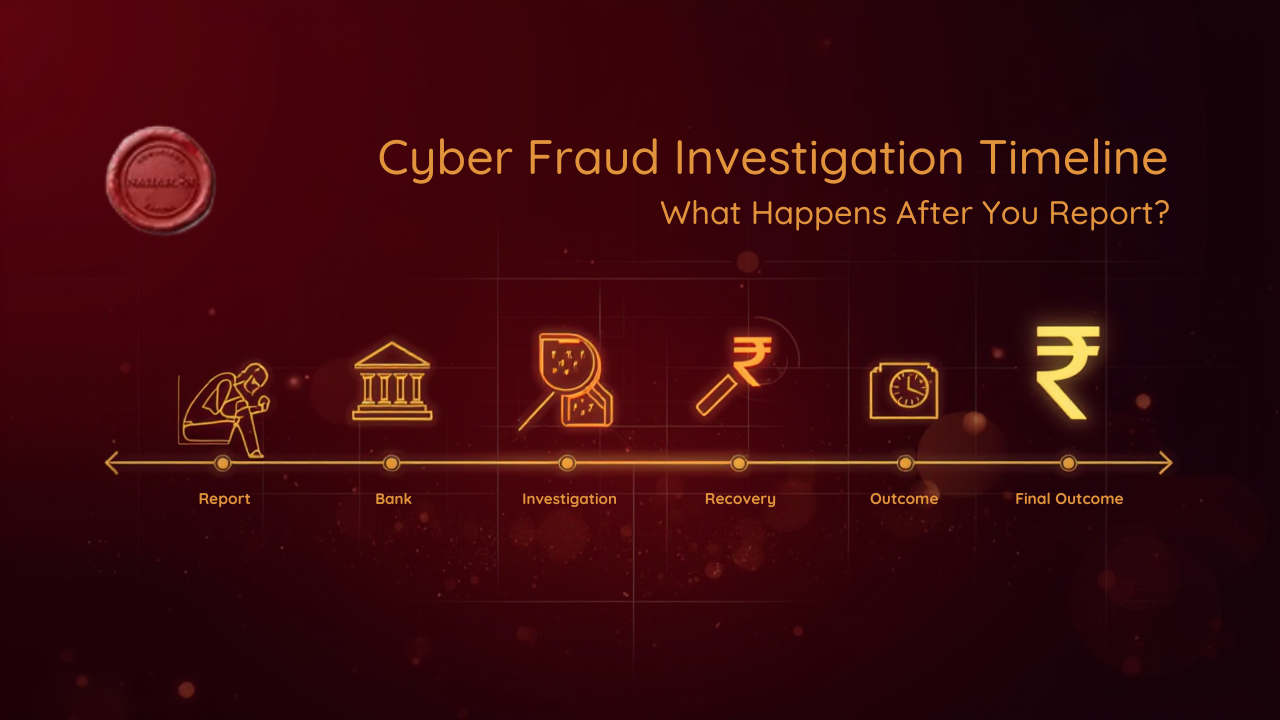
Cyber fraud Investigation timeline in India – You’ve reported the fraud to your bank. You’ve filed a complaint on the National Cyber Crime Reporting Portal. You’ve called the helpline. Now you wait. A week passes with no word. Then two weeks. A month. The silence becomes suffocating, breeding questions that keep you awake: Is anyone even working on my case? Have they forgotten about me? Should I assume the money is gone forever?
This anxiety-filled waiting period is one of the most distressing aspects of cyber fraud victimhood in India. The silence feels like abandonment, but in most cases, it reflects something else entirely: the complex, multi-layered, coordination-heavy nature of cyber fraud investigations. Behind the scenes, your case may be moving through banks, payment networks, cyber cells, and across state jurisdictions—each step governed by protocols, legal requirements, and overwhelming case volumes that create delays invisible to you.
This guide exists to replace anxiety with understanding. It maps realistic timelines, explains what happens during the silence, identifies what speeds cases up or slows them down, and clarifies when you should follow up versus when you should escalate. Most importantly, it sets honest expectations—because false hope of instant recovery often causes more pain than transparent truth.
Quick Answer
Typical investigation durations: Bank liability decisions typically take 30-90 days. Police investigations range from 3 months to over a year. Complete resolution with fund recovery (when possible) often takes 6-18 months or longer for complex cases.
What speeds investigations up: Reporting within hours (not days), single-bank transactions, small to medium amounts, clear evidence trails, and cases within one jurisdiction move fastest.
What slows investigations down: Delayed reporting, inter-state or international elements, multiple mule accounts, cash withdrawals already completed, high case volumes overwhelming investigators, and lack of proper documentation.
When you’ll know outcomes: Bank refund decisions usually arrive within 90 days per RBI timelines. Police provide sporadic updates with major developments (account freezes, arrests) possible within weeks if reported early—but complete case closure can take years.
What Determines Cyber Fraud Investigation Timelines?
No two fraud investigations move at identical speeds. The cyber fraud investigation time in India varies dramatically based on several critical factors:
Type of fraud:
- UPI unauthorized transfers: Fastest to trace (instant digital trail) but often quickest to lose (instant completion and withdrawal)
- Phishing and OTP-sharing frauds: Slower due to complex liability assessment determining if transaction was truly “unauthorized”
- Card fraud (card-not-present): Moderate timeline with established chargeback procedures through card networks
- Investment and loan app scams: Longest investigations involving shell companies, layered transactions, and often cross-border elements
- Digital arrest and impersonation scams: Complex due to multiple victim coordination and organized crime networks
Amount involved:
- Small amounts (under ₹10,000): Often processed faster through standard procedures but may receive lower priority
- Medium amounts (₹10,000-₹5 lakhs): Standard investigation timelines apply
- High amounts (above ₹5 lakhs): Attract deeper scrutiny, higher priority, but also more procedural complexity and legal oversight that can extend timelines
Speed of reporting—the golden window:
- Within 1-3 hours: Maximum chance of freezing funds before withdrawal; best recovery prospects
- Within 24 hours: Good chance of tracing funds across accounts before complete dispersal
- Within 3 days: Qualifies for zero liability under RBI rules if truly unauthorized, but recovery chances diminish
- After 7 days: Limited liability kicks in; recovery prospects drop significantly as funds typically already dispersed
- After weeks/months: Investigation becomes primarily documentation exercise with minimal recovery probability
Jurisdiction and coordination complexity:
- Same bank, same city: Fastest resolution possible—internal coordination only
- Different banks, same city: Moderate delays requiring inter-bank NPCI coordination
- Different banks, different states: Major delays requiring formal Letters of Request between state cyber cells
- International elements: Longest timelines requiring MLAT (Mutual Legal Assistance Treaties) and diplomatic channels
Case volume context: India’s cyber crime cells handle millions of complaints annually with limited staff. Your individual case competes for attention with thousands of others, creating inevitable queue delays regardless of your case’s merit.
Bank-Side Investigation Timelines
Banks handle the crucial first phase of every digital fraud investigation—determining liability and potential recovery through the banking system:
Initial response window (0-72 hours):
- Complaint logged with unique reference number and timestamp
- Affected payment instruments immediately blocked (cards, UPI IDs, accounts)
- Stop payment requests initiated if transaction still pending (rare for completed UPI)
- Attempt to freeze destination account through NPCI or direct bank-to-bank communication
- This immediate action happens within 24-72 hours of reporting
Internal fraud review and account analysis (1-4 weeks):
- Fraud investigation team examines complete transaction forensics:
- Was the correct OTP generated and delivered to registered mobile?
- Was the correct UPI PIN or CVV used?
- What device, IP address, and location initiated the transaction?
- Does the transaction match customer’s historical behavior patterns?
- Were there multiple failed authentication attempts preceding success?
- What security alerts were sent and when?
- This detailed technical analysis determines the bank’s preliminary liability assessment
- Timeline varies based on case complexity and investigation team workload
Coordination with payment networks and other banks (2-8 weeks):
- For card transactions: Chargeback requests sent through Visa/Mastercard/RuPay networks with defined dispute timelines
- For UPI transactions: Recall requests sent through NPCI to beneficiary bank
- Beneficiary bank must investigate their account holder and respond
- Inter-bank coordination is the primary bottleneck—receiving banks operate on their own timelines without customer-facing deadlines
- Multiple follow-ups often required to receive responses
Provisional credit consideration (10 working days per RBI):
- For clearly unauthorized transactions meeting RBI criteria
- Temporary refund during investigation
- Not automatic—requires bank’s preliminary determination of likely customer favor
- Often not provided in cases involving OTP/PIN usage pending full investigation
Final liability decision and communication (30-90 days):
- RBI mandates resolution within 90 days for most digital payment disputes
- Banks must provide written decision with clear reasoning
- Decision may be refund, partial refund, or denial based on investigation findings
- This timeline is legally binding, making it a clear escalation trigger if breached
Cyber Crime Cell Investigation Timelines
Once you file a complaint on cybercrime.gov.in or at a police station, a parallel but fundamentally slower cyber crime complaint process begins focused on criminal prosecution rather than civil recovery:
Case registration and allocation (1-7 days):
- Complaint triaged based on amount, evidence clarity, and case type
- Cognizable offenses (serious crimes) may get immediate FIR registration
- Non-cognizable cases logged as complaints requiring additional evidence
- Assigned to investigating officer based on workload distribution and jurisdiction
- High-value cases or those with complete documentation get faster allocation
Initial evidence collection (2-6 weeks):
- Police send formal written requests to your bank for:
- Complete transaction details and timestamps
- Account statements showing fraud transaction
- Authentication logs (OTP records, device details)
- Any communication records (if email/SMS phishing)
- Similar requests sent to beneficiary bank requiring:
- Account holder KYC details
- Transaction history and withdrawal patterns
- Physical address and contact information
- Banks have 10-20 days to respond per procedural norms
- Delays common due to bank legal departments requiring proper documentation
Suspect identification and verification (4-12 weeks):
- KYC details examined for authenticity (many use stolen/fake documents)
- Physical verification attempted at registered address
- CDR (Call Detail Records) obtained from telecom providers if phone-based fraud
- IP address tracing through ISPs if online fraud
- Cross-referencing with other cases to identify organized networks
Inter-state or multi-jurisdictional coordination (3-6 months or more):
- If suspect account in different state, Letter of Request (LOR) sent to that state’s police
- Receiving state’s cyber cell must assign officer, approach their local bank branch
- This single step can add 2-4 months of pure waiting time
- No expedited process exists for routine cyber fraud cases
- Each additional jurisdiction multiplies delay
Account freezing attempts:
- If suspect account identified with remaining balance, police can request freeze
- Requires judicial approval in many cases
- Fraudsters often empty accounts within hours, making freezes ineffective
- Even frozen accounts may release funds if charges not filed within legal timeframes
Arrest and prosecution (6-24 months or longer):
- Arrest possible if suspect identified, located, and evidence sufficient
- Many cases involve untraceable perpetrators or those outside India
- Charge sheet filing can take 6-12 months after arrest
- Trial proceedings can extend years
- Recovery proceedings separate from criminal prosecution
Typical Timeline Ranges (Reality-Based Scenarios)
Best-case scenarios (2-8 weeks):
- Conditions: Reported within 1-3 hours, funds still in first recipient account, same-bank transaction, clear unauthorized access
- Bank action: Immediate freeze successful, provisional credit within 10 days, full refund within 30-45 days after investigation confirms no customer fault
- Police outcome: May not even require police involvement if bank resolves
- Recovery rate: 70-90% possible in these ideal conditions
- Real-world frequency: Less than 10% of cases meet all these conditions
Average cases (3-8 months):
- Conditions: Reported within 24-72 hours, funds moved across 2-3 accounts, inter-bank coordination needed, liability assessment required
- Bank action: Preliminary investigation 30-60 days, recall attempts partially successful or failed, liability decision 60-90 days
- Police outcome: FIR registered, evidence collected, suspect identification attempted, minimal updates provided to victim
- Recovery rate: 10-30% partial recovery common if funds traced before complete dispersal
- Real-world frequency: Approximately 40-50% of reported cases fall here
Long-pending or complex cases (6-24 months or indefinite):
- Conditions: Delayed reporting (weeks after fraud), investment/loan scams, cryptocurrency involved, international elements, organized networks
- Bank action: Liability assigned to customer in OTP-sharing cases, investigation concluded without recovery
- Police outcome: Investigation ongoing across multiple jurisdictions, suspects unidentified or outside India, case remains open but inactive
- Recovery rate: Under 5% recovery rate; most cases closed without fund return
- Real-world frequency: Approximately 40-50% of reported cases, especially higher-value sophisticated frauds
Why Some Cases Are Closed Without Recovery
Understanding why many investigations end without money recovery helps manage expectations and reduces self-blame:
Money trail exhaustion:
- Fraudsters withdraw cash within minutes or hours of receiving funds
- Money moved through 5-10+ “mule accounts” (accounts opened with fake/stolen KYC by organized networks)
- Once withdrawn as cash, digital trail ends completely—no asset exists to recover
- Cryptocurrency conversion adds another layer making recovery nearly impossible
Layering and quick dispersal:
- Sophisticated operations split incoming funds across multiple accounts instantly
- Micro-transactions to hundreds of accounts confuse trails
- International transfers through hawala or crypto exchanges
- By the time banks coordinate responses, accounts are empty
Legal and technical limitations:
- Banks cannot forcibly reverse completed, authenticated transactions—only request cooperation
- Receiving banks often claim “customer privacy” to delay or deny information sharing
- Police need judicial warrants for many investigative steps, creating procedural delays
- Jurisdictional boundaries limit enforcement capabilities
Mule account complications:
- Many beneficiary accounts opened using stolen identities or paid accomplices
- Physical account holders may be victims themselves (promised work-from-home jobs)
- Prosecuting mules doesn’t recover funds—they’re usually empty intermediaries
Time-bound legal protections:
- Account freezes require renewal if charges not filed within specified periods
- Banks release frozen funds after legal holding periods expire
- Suspects knowing these timelines simply wait out the clock
Resource constraints:
- Cyber cells prioritize high-value or high-profile cases
- Routine small-value cases receive minimal active investigation after initial documentation
- Recovery efforts abandoned when cost exceeds potential recovery amount
National statistics context: Recent data suggests overall recovery rates of 7-15% for cyber frauds in India. Most recovered funds come from cases reported within hours where freezes succeeded before withdrawal.
What Victims Can Do While Investigation Is Ongoing
Waiting doesn’t mean being passive—but effective action differs from frantic action:
Structured follow-up approach:
- Bank follow-up: Contact every 10-15 days (not daily) via email or designated grievance channels
- Always reference complaint number, date filed, and previous communication
- Request specific updates: “Has inter-bank recall been attempted? What was the response?”
- Document every interaction: date, person spoken to, information provided
- Avoid angry or threatening communication—it doesn’t expedite and may alienate helpful staff
Police follow-up:
- Check online portal status weekly if available
- Physical visit or call once monthly for significant cases
- Request update on: evidence collection completion, suspect identification progress, any account freezes achieved
- Provide any new information discovered immediately
- Understand that absence of updates often reflects genuine lack of progress, not negligence
Documentation discipline: Create a comprehensive case file containing:
- All complaint numbers (bank, cyber crime portal, police station)
- Complete transaction details with screenshots
- Timeline of all communications with banks and police
- Copies of all emails, letters, and acknowledgments
- Evidence submitted (call recordings if legal, message screenshots, etc.)
- This becomes critical if escalation needed
When and how to escalate:
Bank escalation triggers:
- No response within 15 days of complaint
- Unsatisfactory response without proper investigation evidence
- No final decision within 90 days
- Action: Escalate to bank’s Grievance Redressal Officer, then RBI Ombudsman if still unresolved
Police escalation triggers:
- No FIR despite serious cognizable offense
- Zero updates for 3-6 months despite repeated follow-ups
- Clear evidence of investigation inaction
- Action: Written complaint to supervisory officer (ACP/DCP of cyber cell), approach courts for investigation direction in extreme cases
What NOT to do:
- Don’t file multiple complaints across different platforms for same incident—creates confusion
- Don’t threaten legal action prematurely before exhausting administrative channels
- Don’t share case details on public social media—may compromise investigation
- Don’t pay anyone claiming they can “expedite” your case—likely additional fraud
Common Myths About Cyber Fraud Timelines
“Money comes back automatically in 24-48 hours”: Reality—Only if transaction still pending (extremely rare for UPI/completed card payments). Completed transactions enter investigation timelines measured in weeks or months. Instant recovery is exception, not rule.
“Banks must resolve everything in 10 days”: Reality—RBI allows 10 working days for provisional credit in clear unauthorized cases, but permits up to 90 days for full investigation and final resolution. The “10-day” rule is often misunderstood as guaranteed refund timeline.
“Police will provide weekly updates on my case”: Reality—Cyber cells handle thousands of cases with limited officers. Updates typically only when significant development occurs (arrest, recovery) or when they need additional information from you. Silence usually means case in queue or investigation at standstill.
“If I don’t hear anything, the case is closed”: Reality—Cases can remain open for years without active progress but without formal closure. Lack of updates reflects resource constraints and case complexity, not necessarily closure. Check status explicitly rather than assume.
“Higher-value cases get solved faster”: Reality—Higher amounts may get priority assignment but also attract more scrutiny, legal procedures, and complexity that can extend timelines. Medium-value cases with clear evidence sometimes resolve faster than high-value complex frauds.
“Hiring a lawyer speeds up investigations”: Reality—Legal intervention helps primarily for procedural violations (forcing banks to respond, compelling police FIR) but cannot override investigation complexity or fund recovery reality. Useful for escalation, not acceleration of core investigative work.
FAQs
Q. How long does cyber crime investigation take in India?
A. Bank liability determinations typically take 30-90 days per RBI guidelines. Police criminal investigations range from 3 months to over 2 years depending on complexity, jurisdiction, and case priority. Complete resolution with fund recovery averages 6-18 months when successful—but many cases remain unresolved indefinitely. To understand how banks determine liability and what RBI guidelines legally require them to follow, see our detailed guide on the role of banks and RBI in digital fraud disputes.
Q. Why is cyber fraud recovery so slow in India?
A. Multiple factors compound: overwhelming case volumes (millions reported annually) relative to investigator capacity, complex inter-bank and inter-state coordination requiring formal procedures, rapid fund dispersal by sophisticated fraudsters, legal limitations preventing forced transaction reversals, and jurisdictional boundaries limiting enforcement across state and international borders.
Q. Can investigation timelines be expedited?
A. Limited options exist. Reporting within first few hours dramatically improves outcomes. Providing complete, organized documentation upfront reduces delays. High-value cases may receive priority. However, no legitimate way to bypass fundamental coordination and procedural requirements. Be wary of anyone claiming they can “speed up” investigations for payment—likely additional scam.
Q. When should a cyber fraud case be escalated?
A. To bank’s Grievance Officer: After 15-20 days without meaningful response. To RBI Ombudsman: After 30 days with unsatisfactory bank response or 90 days without final decision. To senior police: After 3-6 months without any investigation progress despite proper documentation. To courts: Only after exhausting all administrative remedies and for high-value cases justifying legal costs.
Q. What’s the realistic recovery rate for cyber fraud in India?
A. National statistics indicate overall recovery rates of 7-15% across all cyber fraud cases. Recovery rates are much higher (50-70%) for cases reported within 1-3 hours with proper documentation. Rates drop below 5% for cases reported after several days or involving sophisticated organized networks. Social engineering frauds where OTP/PIN were shared have particularly low recovery rates as they’re often deemed “authorized” transactions.
Conclusion
Cyber fraud investigations in India move slowly not primarily because of negligence, but because of structural realities: overwhelming volumes, complex coordination requirements, sophisticated criminal networks, legal and technical limitations, and the simple fact that digital money moves faster than procedural systems can respond. The silence you experience during waiting periods often reflects these systemic constraints rather than abandonment of your case.
Your role shifts from victim awaiting rescue to informed participant managing a long-term process. Patience must coexist with persistence—follow up regularly but realistically, document everything methodically, escalate when timelines are genuinely breached (not just when anxious), and prepare emotionally for the possibility that full recovery may not occur despite best efforts.
Most importantly, let this experience transform your prevention habits. The uncomfortable truth is that recovering lost money remains far more difficult, uncertain, and time-consuming than preventing loss in the first place. Every hour spent understanding fraud prevention practices provides more protection than any investigation timeline ever can.
The system is imperfect and slow—but understanding its realities empowers you to navigate it effectively while protecting yourself better in the future.
Disclaimer: Timelines presented reflect typical cases based on current procedures and constraints as of late 2025. Individual case duration varies significantly. This guide provides expectation-setting information, not legal advice. Consult qualified professionals for case-specific guidance.