
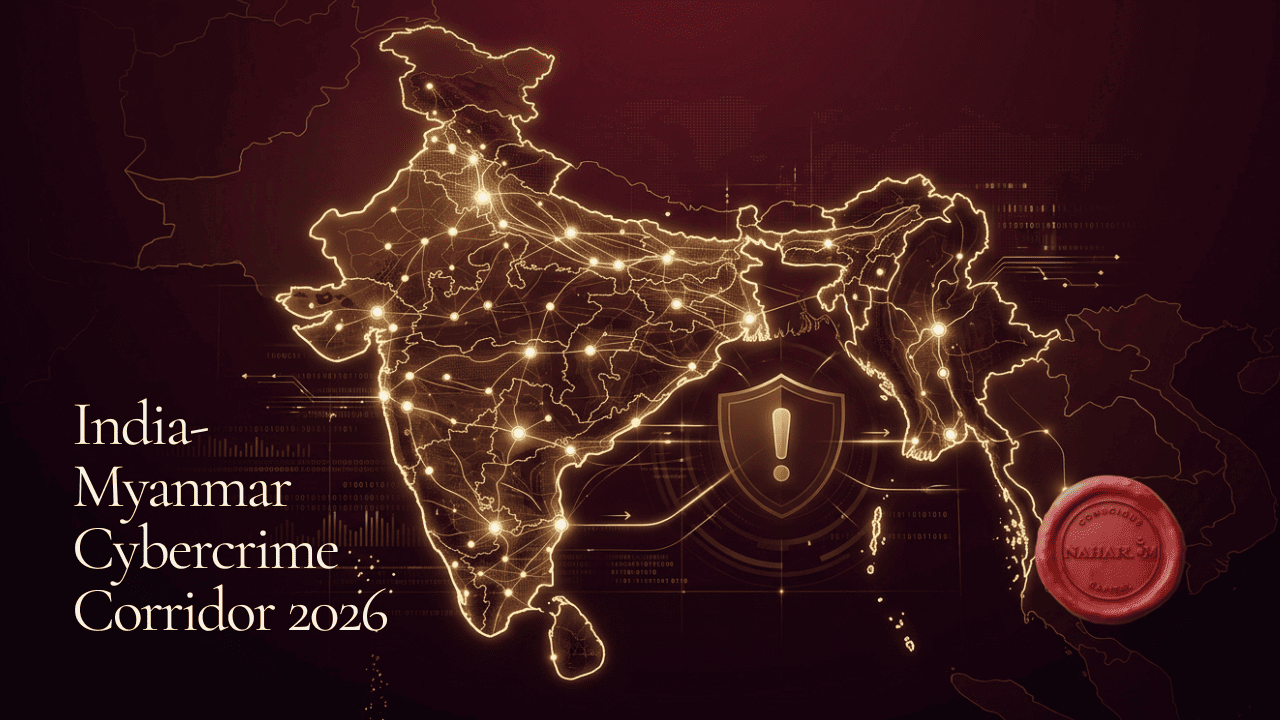
Myanmar’s cybercrime corridor compounds — located primarily in Myawaddy, Shwe Kokko, and KK Park along the Thai-Myanmar border — house thousands of trafficked workers who run industrial-scale fraud operations targeting Indians, including digital arrest scams, pig butchering investment fraud, and task-based earning scams. Chinese criminal syndicates control most operations; funds exit via crypto, hawala, and Dubai.
Table of Contents
What Are Myanmar Scam Compounds?
Myanmar scam compounds are heavily fortified, self-contained criminal campuses located along the Thai-Myanmar border — primarily in Myawaddy, Shwe Kokko, and KK Park. Controlled by ethnic armed organisations (EAOs) and Chinese criminal syndicates, these compounds house thousands of trafficked workers forced to run industrial-scale fraud operations targeting victims across Asia, with Indians now the second-most targeted nationality globally.
In 2024 alone, cybercrime originating from Southeast Asia — with Myanmar as the primary hub — cost Indians Rs 11,333 crore in confirmed losses.
Introduction: Why This Matters Right Now
India’s digital economy crossed 700 million UPI users in 2024. That scale, combined with high English proficiency, deep respect for government authority, and a large NRI population with cross-border financial exposure, has made India the single most attractive target outside China for Myanmar-based cybercrime corridor networks.
The CBI, Interpol, and India’s Ministry of External Affairs have all formally confirmed: a significant and growing share of digital arrest scams, pig butchering investment frauds, and task-based earning scams targeting Indians are physically operated from compound-based cybercrime centres inside Myanmar.
This is not a distant geopolitical issue. For HNIs, family offices, corporate finance teams, and everyday digital payment users, this is active operational threat intelligence.
The Myanmar Fraud Corridor: Geography and Control
Understanding where these compounds are located — and who controls them — is foundational to understanding why they are so difficult to dismantle.
KK Park, Myawaddy Controlling entity: Karen National Army (KNA). Estimated workforce: 10,000+ trafficked workers. Primary fraud types: digital arrest impersonation, pig butchering investment fraud.
Shwe Kokko, Myawaddy District Controlling entity: Karen Border Guard Force (BGF). Estimated workforce: 5,000+ workers. Primary fraud types: investment fraud, task-based earning scams.
Hpa-Lu Controlling entity: Border militia. Estimated workforce: 2,000+ workers. Primary fraud types: cryptocurrency investment fraud.
Sihanoukville, Cambodia Controlling entity: Chinese syndicates operating overseas. Estimated workforce: 20,000+ workers. Primary fraud types: investment fraud, romance fraud.
Golden Triangle SEZ, Lao PDR Controlling entity: Kokang Chinese syndicates. Estimated workforce: 15,000+ workers. Primary fraud types: pig butchering, crypto scams.
The entire corridor stretches across three countries, exploiting weak governance, active conflict zones, and complicit local militias. This is why no single bilateral enforcement action has been sufficient.
How Myanmar Scam Compounds Target Indians Specifically
Why India Is the Priority Target
Several structural factors make India disproportionately attractive to these networks:
India operates the world’s largest digital payment base, with over 700 million UPI users — creating an enormous pool of financially active, reachable targets. High English proficiency across India’s urban and semi-urban population enables scammers to deploy sophisticated social engineering scripts without language barriers. Cultural deference to government authority — police, CBI, Enforcement Directorate, Supreme Court — makes digital arrest scripts extraordinarily effective. The large NRI population, with overseas financial accounts and legitimate fear of international regulatory scrutiny, creates a ready-made target demographic for fund-freeze impersonation scams. Finally, weak India-Myanmar extradition frameworks mean operational risk for compound controllers is near zero.
The Script Library: Industrial-Scale Social Engineering
CBI investigations have revealed that Myanmar compounds maintain a structured, regularly updated library of fraud scripts translated into Hindi, Tamil, Telugu, Bengali, and Marathi. Scripts are categorised by target profile — government official, NRI, elderly professional, young investor — and each includes objection-handling protocols, escalation scripts, and what internal compound documents call “maximum extraction” techniques.
This is not improvised fraud. It is systematised, data-driven criminal operations running at corporate scale.
Types of Scams Originating From Myanmar Targeting Indians
Digital Arrest Scam
The victim receives a call from someone impersonating a CBI officer, ED official, customs authority, or Supreme Court judge. They are told they are under “digital arrest” for an alleged financial crime — money laundering, drug trafficking, or foreign exchange violation. They are kept on video call for hours or days, psychologically isolated, and coerced into transferring large sums to “clear” their name. This scam type disproportionately targets HNIs, retired professionals, and NRIs.
Pig Butchering Investment Fraud (Sha Zhu Pan)
A long-duration romance or friendship scam where the fraudster cultivates trust over weeks or months via WhatsApp, Instagram, or LinkedIn before introducing a “highly profitable” cryptocurrency or stock investment platform. The victim invests increasing amounts, sees fabricated returns, and is eventually locked out — losing their entire investment. Average losses in documented Indian cases: Rs 30 lakh to Rs 5 crore.
Task-Based Earning Scam
Victims are offered simple online tasks — liking YouTube videos, reviewing products, rating apps — with small initial payments to establish credibility. They are then asked to make “investment deposits” to unlock higher-paying tasks. The platform disappears once deposits reach a threshold. This scam specifically targets young urban professionals and homemakers.
Fake Job Trafficking Lure
Advertisements for IT support, data entry, or digital marketing roles in Thailand, Cambodia, or Myanmar — circulated on LinkedIn, Telegram, and job portals — are used to traffic victims into compound operations. Once inside, victims are either forced to run scam operations themselves or sold between compounds.
Cryptocurrency Investment Fraud
Victims are directed to fake but professionally designed crypto trading platforms that show fabricated returns. Customer support, withdrawal processes, and market data are all simulated. Funds are immediately laundered through USDT and hawala channels upon deposit.
Money Flow: How Fraud Proceeds Exit India
Understanding the laundering architecture is critical for both law enforcement and corporate risk managers.
Victim funds are first transferred to domestic mule accounts — typically held by unwitting or coerced third parties across India. Within hours, funds are moved through three to five additional mule account layers to break traceability. The consolidated funds are then converted to USDT (Tether) via peer-to-peer crypto exchanges operating outside RBI oversight. USDT is transferred to wallets controlled by Myanmar-based or Chinese syndicate operators. Final conversion to cash happens through hawala networks in Dubai, Singapore, and Hong Kong.
Distribution within the criminal network follows a consistent pattern: 30–40% to compound controllers, 20–30% to militia protection fees, with the remainder flowing to syndicate leadership.
This architecture means that funds reaching the crypto conversion stage have a recovery probability below 5%.
India’s Government Response: What Is Being Done
Operation Chakra (I4C and CBI)
India’s Indian Cyber Crime Coordination Centre (I4C), in coordination with the CBI, has been conducting Operation Chakra — a sustained crackdown on domestic mule account networks that service Myanmar-based fraud operations. Results through 2024–25: 22 syndicates dismantled, 175 arrests, Rs 198 crore in proceeds seized.
MEA Diplomatic Intervention
India’s Ministry of External Affairs formally raised the Myanmar cybercrime corridor compounds issue with Myanmar’s State Administration Council (SAC) and the Thai government in 2024. India joined the Bali Process multilateral framework on cross-border cybercrime. Over 1,400 trafficked Indians have been repatriated from Myanmar compounds since 2023.
FATF Grey-Listing Pressure
Myanmar has been on the FATF grey list since 2020. While this has increased international scrutiny on Myanmar-linked formal financial flows, effectiveness against compound-based fraud is limited — the majority of fund flows bypass formal banking entirely through crypto and hawala channels.
Interpol Red Notices
As of early 2026, Interpol has issued Red Notices for 14 individuals linked to Myanmar cybercrime corridor compounds operations targeting Indians. Three have resulted in arrests — in Thailand, Malaysia, and India respectively.
Victim Recovery Options: What Works and What Doesn’t
I4C Helpline 1930 (Immediate account freeze) Timeline: 1–6 hours post-report. Success rate: 22–28% if reported within one hour of transfer. Best for: domestic mule account funds before crypto conversion. This is the single most time-sensitive intervention available to victims.
CBI or State Police FIR Timeline: Weeks to months. Success rate: 5–10% for documented losses. Best for: large losses with clear digital trail — bank records, call logs, transaction screenshots.
Interpol Red Notice Timeline: Months to years. Success rate: Below 5% for individual recovery. Best for: corporate or HNI cases with international dimensions.
Cyber Insurance Claim Timeline: 30–90 days. Success rate: 60–80% if a qualifying policy is in place. Critical caveat: standard cyber insurance policies frequently exclude social engineering fraud — a dedicated endorsement is required.
Crypto Tracing and Legal Freezing Timeline: 3–12 months. Success rate: 8–15% if the destination wallet is identified early. Best for: cases where USDT wallet addresses can be recovered from transaction records.
The practical conclusion: report to 1930 within 60 minutes of any suspected fraud transfer. Every hour reduces recovery probability significantly.
Corporate and HNI Protection Framework
For High Net Worth Individuals and Family Offices
Conduct an annual cyber threat assessment specifically covering social engineering risks targeting HNI profiles. Establish a rigid verification protocol for all large fund transfers — no transfer above Rs 10 lakh should be approved without dual physical authorisation from two known individuals. Brief household staff, domestic employees, and extended family members — these are the most common entry points for initial contact and intelligence gathering. Retain a certified cyber incident response firm on retainer with a two-to-four-hour response SLA. Secure a standalone social engineering cyber insurance policy — most standard policies do not cover this specific loss category.
For Corporate Security Officers
Include Southeast Asia cybercrime corridor compounds briefings in quarterly security awareness training programmes. Implement a company-wide zero-tolerance policy for approving fund transfers based solely on phone or video call instruction — regardless of apparent caller authority. Subscribe to I4C’s Cyber Dost intelligence feed for real-time fraud pattern updates. Conduct annual social engineering simulation exercises targeting finance and HR teams — the two highest-risk roles in any organisation. Maintain documented incident response protocols that do not rely on individual judgement under pressure.
Frequently Asked Questions
Why are Myanmar scam compounds so difficult to shut down?
The compounds operate in territories controlled by ethnic armed organisations outside Myanmar’s central government authority. The ongoing civil war has further fragmented enforcement capacity across the country. Chinese syndicate involvement adds a geopolitical layer that makes bilateral pressure diplomatically complex and operationally slow. KK Park alone has operated for over five years despite international attention.
Which scam types targeting Indians originate from Myanmar?
Digital arrest impersonation scams, pig butchering investment romance fraud, task-based earning scams, fake job trafficking lures, and cryptocurrency investment fraud are the five primary categories. Digital arrest scams and pig butchering account for the largest share of reported financial losses.
What is India’s government doing about Myanmar cybercrime corridor compounds?
India is running Operation Chakra through I4C and CBI, engaging diplomatically via MEA and Interpol, participating in the Bali Process multilateral framework, and has repatriated over 1,400 trafficked Indians since 2023. Domestic mule network crackdowns have yielded 175 arrests and Rs 198 crore in seized proceeds as of 2025.
Can fraud victims recover money sent to Myanmar-based scammers?
Funds intercepted at the domestic mule account stage have a 22–28% partial recovery rate if reported to helpline 1930 within one hour. Funds that reach cryptocurrency conversion have a recovery rate below 5%. Cyber insurance with a social engineering endorsement remains the most reliable financial protection mechanism for significant losses.
How do family offices protect themselves from targeted cybercrime?
The five most effective measures are: annual HNI-specific threat assessments, dual-authorisation protocols for all large transfers, dedicated social engineering cyber insurance, household staff security briefings, and a retained cyber incident response firm.
What should I do if I suspect I have been trafficked or know someone trafficked into a compound? Contact India’s MEA helpline immediately: 1800-11-2490 (Madad Portal). Do not attempt independent contact with compound operators.
Key Risks and Structural Limitations
Myanmar’s active civil war severely limits any bilateral law enforcement cooperation with the current junta. Chinese syndicate control over compound operations means that meaningful disruption requires Chinese government pressure — a diplomatically sensitive and slow-moving lever. Fraudsters are increasingly migrating to privacy coins and decentralised exchanges, which are substantially harder to trace than USDT flows. FATF pressure has not materially impacted hawala channels. Indian courts process cyber fraud cases over multi-year timelines, leaving victims in prolonged financial and psychological uncertainty.
Red Flags to Identify These Scams
Any call claiming you are under “digital arrest” is fraud — no Indian law enforcement agency conducts arrests via video call. Any investment platform introduced through a WhatsApp or social media contact promising abnormally high returns is a pig butchering operation. Any online task platform requiring an upfront deposit to “unlock” earnings is a task scam. Any overseas job offer that requests your passport before arrival and promises unusually high IT salaries should be verified through the MEA Madad portal before engagement.
Conclusion
The India-Myanmar cybercrime corridor is the physical operational headquarters of the fraud networks that stole Rs 11,333 crore from Indians in 2024. Every digital arrest call, every pig butchering WhatsApp message, every fake task app login traces back to a compound in Myawaddy, Shwe Kokko, or the Golden Triangle.
The response has to be multi-layered and simultaneous: sustained government pressure through diplomatic and law enforcement channels, aggressive domestic crackdowns on mule account networks, corporate-grade protection frameworks for HNIs and family offices, and public awareness programmes that outpace the scammers’ adaptation cycles.
For individuals and organisations in the crosshairs, the most important actions are the simplest: report fraud within 60 minutes to 1930, never transfer money under telephone instruction alone, and treat social engineering cyber insurance as non-negotiable infrastructure — not optional coverage.
Key Resources
- National Cyber Crime Helpline: 1930
- MEA Madad Portal (Trafficking): 1800-11-2490
- I4C Cyber Dost (Real-time Intelligence): cyberdost.gov.in
- FATF Myanmar Country Profile: fatf-gafi.org
- Bali Process Cybercrime Framework: baliprocess.net
Last updated: March 2026. This brief is intended for security professionals, HNIs, family offices, and corporate risk teams. It does not constitute legal advice.