
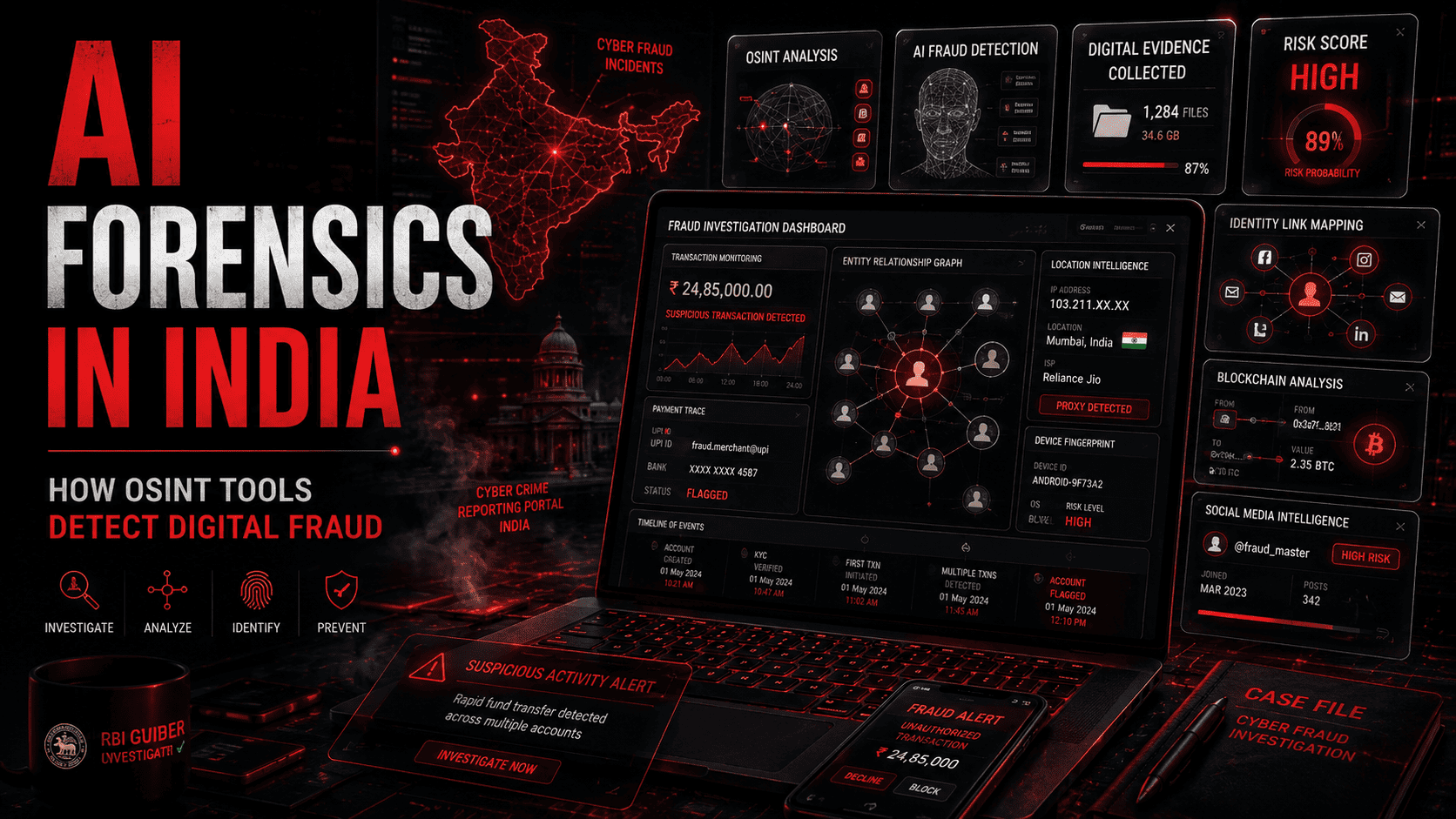
India recorded over 2.27 million cybercrime complaints in 2024. Traditional investigation methods can’t keep pace. AI forensics — powered by OSINT tools — is now the front line of fraud detection for fintech companies, banks, insurers, law enforcement agencies, and digital investigation startups across the country. This guide covers what AI forensics is, which OSINT tools matter, how investigations actually work, the legal framework, and what’s coming next.
Table of Contents
The Scale of the Problem: Why India Urgently Needs AI Forensics
India’s digital economy is one of the fastest-growing in the world. With over 86% of households now connected to the internet and UPI processing billions of transactions every month, the country’s digital infrastructure is extraordinary. But it’s also a target.
Cybercrime incident reports on India’s National Cyber Crime Reporting Portal climbed to 2.27 million in 2024 — nearly five times the 2021 level. The NCRB’s Crime in India 2024 report recorded a stark 17% surge in cybercrimes, reflecting a rapid transition from traditional physical offences to sophisticated, borderless digital crimes driven by AI-enabled frauds, digital arrest scams, and organised cyber syndicates. Indiaspend Drishti IAS
The financial damage is severe. Frauds involving card, internet, and other digital payments of ₹1 lakh and above increased 11 times, and the money involved rose 12 times since 2020–21, according to the Reserve Bank of India. Indiaspend
Traditional investigation methods — manual document review, physical surveillance, basic IP tracing — simply cannot match the speed, volume, and sophistication of modern cyber fraud. That is precisely why AI forensics and OSINT (Open Source Intelligence) tools have moved from niche specialisations to operational necessities across India’s law enforcement agencies, fintech companies, insurance firms, banks, and private investigation startups.
India’s digital forensics market generated revenue of USD 540.5 million in 2024 and is expected to reach USD 1,658.6 million by 2030, growing at a CAGR of 21% — making it one of the fastest-expanding forensics markets in the world. Grand View Research
What Is AI Forensics?
AI forensics is the application of artificial intelligence, machine learning, and advanced data analysis to identify, investigate, preserve, and present digital evidence of cybercrime, financial fraud, identity theft, and other illegal activities conducted through digital channels.
It differs from traditional digital forensics in three important ways:
Speed: AI can process millions of data points — transaction logs, social media activity, device metadata, communication records — in hours rather than weeks.
Pattern recognition: Machine learning models detect subtle anomalies that a human investigator would almost certainly miss, such as micro-patterns in transaction timing or linguistic fingerprints across multiple fake identities.
Predictive capability: Rather than only investigating fraud after it happens, AI systems can flag suspicious behaviour in real time, enabling prevention alongside investigation.
AI forensics does not replace the human investigator — it dramatically amplifies what that investigator can see and do.
What Is OSINT and Why Does It Matter for Fraud Investigations in India?
OSINT (Open Source Intelligence) refers to the collection and analysis of information from publicly available sources to support an investigation. These sources include social media platforms, public government databases, domain registries, court records, news archives, blockchain ledgers, and the dark web.
In the Indian fraud investigation context, OSINT is often the starting point of any case. Before an investigator can trace a fraudster’s financial trail, they need to understand who that person claims to be — and OSINT is what builds that picture.
Key categories of OSINT sources used in Indian fraud investigations:
| OSINT Source | What It Reveals | India-Specific Use Case |
|---|---|---|
| Social media (Facebook, Instagram, X, LinkedIn) | Identity verification, location history, network connections | Detecting fake KYC identities, loan fraud applicants |
| WHOIS / domain records | Who registered a fraudulent website and when | Busting fake investment platforms and phishing sites |
| Public government databases | Company registrations, court filings, property records | Verifying borrower claims in loan fraud cases |
| Blockchain explorers | Crypto wallet addresses and transaction flows | Tracing proceeds of crypto scams |
| Dark web forums | Stolen data, compromised credentials, fraud networks | Identifying data breach sources |
| News archives | Past fraud history, aliases, criminal associations | Background verification in high-value transactions |
| IP intelligence tools | Geographic location, ISP data, device fingerprints | Locating fraud operators masking behind VPNs |
When AI is layered on top of OSINT data collection, investigators can rapidly link identities across multiple platforms, detect linguistic patterns that suggest the same person is operating multiple accounts, and map entire fraud networks rather than just individual suspects.
Top OSINT Tools Used in AI Forensics in India (2026)
This is one of the most practically searched questions among investigators, compliance teams, and fintech risk professionals. Here is a detailed breakdown of the tools that are actually in use:
Maltego
The industry standard for link analysis and entity mapping. Maltego visualises connections between people, companies, email addresses, domains, phone numbers, and social profiles as a network graph. For Indian fraud investigations — particularly loan fraud rings and fake investment scheme operators — Maltego makes it possible to see how apparently unconnected individuals are actually part of the same operation. It integrates with hundreds of data sources and can be extended with custom transforms for Indian-specific databases.
Best for: Organised fraud network mapping, multi-entity financial fraud, insurance fraud rings.
Shodan
Often called “the search engine for the internet of things,” Shodan scans and indexes internet-connected devices — servers, routers, webcams, industrial equipment — and shows what they are exposing to the public internet. In fraud investigations, Shodan helps identify the infrastructure behind fraudulent websites and phishing operations.
Best for: Infrastructure investigation, identifying servers hosting fraudulent platforms, cyber threat intelligence.
SpiderFoot
An automated OSINT collection platform that aggregates data from over 200 sources simultaneously — social media, WHOIS records, threat intelligence feeds, dark web sources, DNS data, and more. For investigators who need comprehensive background intelligence on a suspect quickly, SpiderFoot dramatically reduces manual research time.
Best for: Comprehensive suspect profiling, automated threat analysis, rapid initial reconnaissance.
IntelX (Intelligence X)
A search engine and data archive that indexes leaked datasets, dark web content, and historical public data that standard search engines don’t reach. Critically relevant for Indian investigations involving compromised Aadhaar-linked databases, leaked financial records, or credentials for sale on underground forums.
Best for: Data breach investigations, dark web monitoring, leaked document searches.
Recon-ng
An open-source, modular reconnaissance framework that runs in a command-line environment and automates intelligence gathering from public sources. Preferred by technically oriented investigators and Indian cybercrime labs for its extensibility and precision.
Best for: Structured recon workflows, customisable intelligence pipelines, technical forensic teams.
INDOSINT
A relatively new open-source OSINT framework specifically built for the Indian context, with native support for 10+ Indian languages including Hindi, Tamil, Bengali, Telugu, and Marathi. This matters enormously in India, where fraud operations often communicate in regional languages that generic OSINT tools miss entirely.
Best for: India-specific investigations, multilingual social media analysis, regional fraud detection.
Blockchain Explorers (Etherscan, BscScan, Blockchain.com)
As crypto-related fraud has exploded in India — crypto fraud accounting for over 81% of digital fraud cases handled by some forensic firms — blockchain explorers have become standard tools. They allow investigators to trace the movement of funds across wallets, identify exchange addresses, and reconstruct the financial chain of a crypto scam. Cyber Privilege
Best for: Cryptocurrency fraud investigation, tracing stolen funds, smart contract analysis.
How AI Enhances OSINT: The Technology Behind the Investigation
Raw OSINT data collection is only the beginning. Here is what AI specifically adds to the investigative process:
Behavioural anomaly detection: ML models trained on known fraud patterns can flag accounts and transactions that deviate from expected behaviour — for example, a newly registered company applying for multiple bank loans simultaneously, or a user whose typing pattern on a banking app changes suddenly.
Natural Language Processing (NLP): AI can analyse large volumes of text — chat logs, emails, social media posts — across multiple Indian languages to identify threatening language, coordination signals between fraudsters, or patterns suggesting scripted communication (common in call centre fraud operations).
Facial recognition and deepfake detection: With deepfake-enabled KYC fraud becoming an increasing concern for Indian banks and fintechs, AI-based facial analysis tools can flag video KYC submissions where the face shows inconsistencies characteristic of synthetic generation.
Network graph analysis: AI algorithms applied to Maltego-style link analysis can automatically identify central “hub” nodes in a fraud network — the organisers rather than the foot soldiers — prioritising investigative focus.
AI summarisation: Large language models can now synthesise intelligence from hundreds of OSINT sources into a structured investigation brief in minutes, reducing the cognitive load on human analysts.
The Real-World Fraud Investigation Workflow
Understanding how AI forensics and OSINT work in practice is essential for organisations building these capabilities. Here is the standard investigative framework used by professional digital forensics teams in India:
Step 1 — Complaint and triage A fraud complaint is received — from an individual, a bank’s fraud risk team, an insurer, or law enforcement. The case is classified by fraud type (identity fraud, financial fraud, account takeover, etc.) and priority, based on the financial value at risk and the evidence trail available.
Step 2 — Initial identity validation Investigators verify the claimed identity of the suspect or entity using public records — MCA21 (company registry), voter ID databases, court records, and social media. OSINT tools like SpiderFoot and Maltego are deployed at this stage to build an initial entity map.
Step 3 — OSINT data extraction A comprehensive intelligence sweep is conducted across social media, domain records, dark web sources, and financial databases. Every digital footprint associated with the suspect — email addresses, phone numbers, device IDs, IP addresses — is documented and cross-referenced.
Step 4 — AI anomaly detection and pattern analysis The collected data is processed through AI models that flag inconsistencies, detect synthetic identities, link previously unconnected entities, and score the overall fraud risk of the suspect or transaction.
Step 5 — Network mapping Maltego or similar link analysis tools visualise the connections between the suspect and other individuals, companies, bank accounts, and platforms. This is where individual fraud cases often reveal organised rings.
Step 6 — Financial trail reconstruction Transaction records (obtained through legal process from banks and payment platforms), combined with blockchain analysis for crypto-linked cases, reconstruct the movement of funds from victim to fraudster.
Step 7 — Evidence packaging and reporting All findings are compiled into a legally structured investigation report, with digital evidence preserved in accordance with the Bharatiya Sakshya Adhiniyam, 2023 (India’s updated evidence law) to ensure admissibility in court.
Step 8 — Law enforcement escalation or civil action The report is submitted to the relevant cyber crime police unit, CERT-In, or used as the basis for civil recovery proceedings.
Key Fraud Types Where AI Forensics Is Making a Difference in India
UPI and payment fraud: AI transaction monitoring systems now flag suspicious patterns in real time. Over 9.42 lakh SIM cards and 2,63,348 IMEIs linked to cyber frauds have been blocked as a direct result of AI-enabled detection by Indian law enforcement and telecom regulators working together. Press Information Bureau
Loan and KYC fraud: Fintech lenders use AI to detect synthetic identities — fraudsters who stitch together real and fabricated personal data to create borrowers who don’t exist. OSINT tools cross-reference the applicant’s digital footprint against their claimed identity to surface inconsistencies.
Insurance claim fraud: AI forensics is used to analyse the consistency of claim documentation, identify claimants with suspicious digital histories, and detect organised fraud rings where multiple individuals file suspiciously similar claims.
Deepfake-enabled identity fraud: Generative AI has made it possible to create convincing fake video KYC submissions. AI-based deepfake detection tools are now a standard part of the onboarding process at major Indian banks and fintechs.
Crypto investment scams: With investment fraud accounting for roughly 50% of reported cybercrime losses in some cities, blockchain forensics tools are used to trace the flow of victim funds, identify exchange wallets, and support law enforcement seizure requests.
Digital arrest scams: Digital arrest scam incidents touched 1,23,672 in 2024 — these are operations where fraudsters impersonate CBI or police officers and extort victims. AI forensics helps trace the call routing infrastructure and payment chains behind these operations. Indiaspend
Legal and Regulatory Framework: Is OSINT Legal in India?
This is one of the most common questions among compliance professionals and investigators building AI forensics practices.
Yes, OSINT from publicly available sources is legal in India. Accessing information that individuals and organisations have made publicly available — social media profiles, public company filings, court records — does not violate any Indian law.
However, several important legal considerations apply:
Digital Personal Data Protection Act, 2023 (DPDP Act): Investigators must be careful about how they collect, store, and process personal data, even if that data is publicly available. The DPDP Act creates liability for organisations that handle personal data without appropriate legal basis.
Bharatiya Sakshya Adhiniyam, 2023: This updated evidence law governs the admissibility of electronic evidence in Indian courts. Forensic investigators must ensure digital evidence is collected and preserved with an unbroken chain of custody and certified appropriately (analogous to the previous Section 65B certificates under the Indian Evidence Act).
IT Act, 2000 (as amended): Certain investigative techniques — such as accessing systems without authorisation or intercepting communications — remain illegal regardless of intent. Legitimate OSINT stays strictly within publicly available and legally accessible data.
CERT-In compliance: Organisations that discover cyber breaches during investigations are subject to CERT-In’s mandatory reporting requirements, which require reporting within six hours of discovery.
The practical takeaway: ethical, legally conducted OSINT and AI forensics is entirely viable in India, but investigations must be designed with legal admissibility in mind from the very start, not treated as an afterthought.
The Startup Ecosystem: Indian Companies Working in AI Forensics
India’s AI forensics startup ecosystem is concentrated primarily in Bengaluru, Hyderabad, Pune, and Gurgaon — the cities with the deepest talent pools in cybersecurity, data science, and legal technology.
Key areas where Indian startups are building:
RegTech and fraud risk platforms that integrate AI forensics directly into the onboarding and credit assessment workflows of banks and fintech lenders, flagging suspicious applications before funds are disbursed.
Insurance fraud detection platforms that cross-reference claim data against social media, public records, and prior claim history using AI to score fraud probability.
Cyber investigation services offering OSINT-based due diligence for corporate clients, including background verification of high-value counterparties and pre-transaction fraud screening.
Law enforcement technology — several Indian startups are working with state police cyber cells to build AI-powered case management and intelligence tools. Maharashtra’s MahaCrimeOS, built in collaboration with Microsoft, reportedly reduces case resolution time from months to hours using AI assistance.
The Indian government has emphasised digital forensic training at various levels, further fuelling growth in this sector and positioning India as a strategic player in the global digital forensics landscape. Market Research Future
For entrepreneurs, the opportunity is significant. The Union Budget 2025–26 allocated ₹782 crore specifically for cybersecurity projects, signalling sustained government investment in the infrastructure that forensics startups can build on. Press Information Bureau
Challenges Facing AI Forensics in India
Acknowledging the obstacles is just as important as understanding the opportunities:
Skill shortage: Digital forensics requires a rare combination of technical, legal, and investigative expertise. India currently faces a significant shortage of professionals who bridge all three domains.
Data silos: Effective AI forensics requires access to data across financial institutions, telecom operators, and government databases. These silos are only slowly being addressed through frameworks like the Account Aggregator network.
False positive risk: Overly aggressive AI fraud detection systems can flag legitimate users — a major concern for financial inclusion in a country where many first-time digital payment users display behaviour patterns that superficially resemble fraud. In 2024, 60% of fraud victims were individuals making their first digital payment, which illustrates the complex balance investigators and platforms must strike. India Data Map
Legal admissibility gaps: Despite improvements in Indian evidence law, practical challenges remain around ensuring AI-generated insights meet evidentiary standards in court, particularly when the underlying ML model’s reasoning is not easily interpretable.
Cross-border complexity: A significant portion of cyber fraud targeting India originates from overseas — particularly from organised operations in Southeast Asia. Coordinating investigations across jurisdictions remains slow and difficult.
The Future of AI Forensics in India: 2026 and Beyond
Several trends are shaping where the field goes next:
Real-time fraud scoring: Rather than investigating fraud after the fact, financial institutions are deploying AI systems that score every transaction and onboarding event in real time, enabling prevention. The Indian Cyber Crime Coordination Centre (I4C), working with IIT Bombay, has developed real-time suspect scoring for mule accounts.
Agentic AI investigations: The next generation of forensics tools will use AI agents that autonomously conduct multi-step OSINT investigations — following a lead across platforms, cross-referencing databases, and surfacing connections without requiring a human to direct each step.
Multimodal forensics: AI systems are increasingly capable of analysing audio, video, images, and text simultaneously — critical for deepfake detection and for processing the mixed-media evidence that modern fraud cases generate.
Predictive intelligence: Moving from reactive investigation to proactive identification of fraud infrastructure before attacks are launched — scanning for newly registered suspicious domains, monitoring dark web chatter for planned fraud campaigns, and flagging emerging fraud patterns before victims are targeted.
Regulatory-driven adoption: As CERT-In mandates, RBI fraud reporting requirements, and the DPDP Act create compliance obligations, organisations that previously treated forensics as optional will be compelled to invest in formal AI-powered investigation capabilities.
Frequently Asked Questions
What is AI forensics?
AI forensics is the use of artificial intelligence, machine learning, and automated data analysis to investigate digital crimes, detect fraud, and produce evidence suitable for legal proceedings. It combines traditional digital forensics methodology with AI’s ability to process large datasets and identify patterns at scale.
What are OSINT tools?
OSINT (Open Source Intelligence) tools are software applications that collect, aggregate, and analyse publicly available information from sources such as social media, domain registries, public databases, blockchain ledgers, and the dark web. They are a core component of modern fraud investigations.
Which OSINT tools are best for fraud investigations in India?
For link analysis and network mapping: Maltego. For automated broad-spectrum collection: SpiderFoot. For dark web and leaked data: IntelX. For Indian-language social media analysis: INDOSINT. For crypto fraud tracing: blockchain explorers such as Etherscan. The right combination depends on the fraud type being investigated.
Is OSINT legal in India?
Collecting and analysing publicly available information is legal in India. However, investigators must comply with the Digital Personal Data Protection Act, 2023, the Bharatiya Sakshya Adhiniyam, 2023 (for evidence admissibility), and the IT Act, 2000. Unauthorised access to private systems is illegal regardless of investigative intent.
Is AI-generated evidence admissible in Indian courts?
Digital evidence is admissible under the Bharatiya Sakshya Adhiniyam, 2023, provided it is collected and preserved with proper chain of custody and certified appropriately. AI-generated analysis can support an investigation but typically needs to be validated by a qualified human expert for court use. The “black box” interpretability of some AI models remains a practical challenge.
Which industries in India use AI forensics most?
Banking and financial services, fintech lending platforms, insurance companies, e-commerce platforms, and law enforcement agencies are the primary users. Corporate due diligence firms and HR tech companies focused on background verification are growing users as well.
How do I report a cyber fraud in India?
File a complaint at the National Cyber Crime Reporting Portal (cybercrime.gov.in) or call the dedicated helpline 1930 for immediate assistance.
Conclusion: AI Forensics Is No Longer Optional
India’s cyber fraud crisis is not going to resolve itself. Cybercrime emerged as the biggest concern in the NCRB’s 2024 report, increasing 17% and driven by AI-enabled frauds, digital arrest scams, and organised cyber syndicates — the very same technologies and tactics that AI forensics is designed to counter. Drishti IAS
For banks, fintechs, insurers, and enterprise risk teams: the question is no longer whether to invest in AI-powered investigation and fraud detection capabilities, but how quickly you can build them. For investigators and startups: India’s market is growing at over 20% annually, the regulatory environment is moving in the right direction, and the talent and tooling have never been more accessible.
The fraudsters are using AI. The investigators who catch them need to as well.
For businesses looking to implement AI-driven fraud detection, or investigators building OSINT workflows for the Indian market, authoritative resources include CERT-In (cert-in.org.in), the RBI’s cybersecurity guidelines (rbi.org.in), and the National Cyber Crime Reporting Portal (cybercrime.gov.in).