
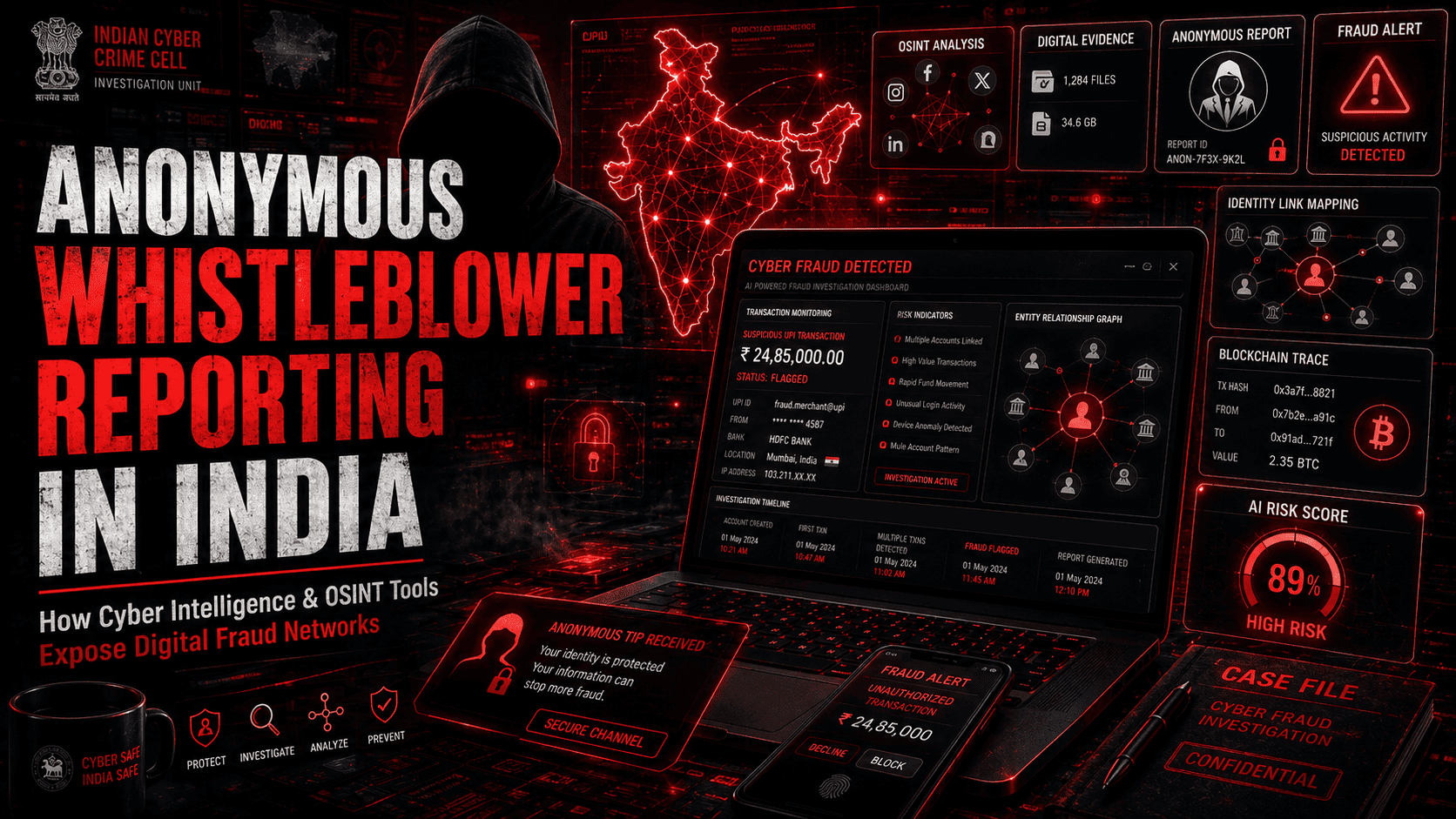
In India, cyber fraud can be reported through the National Cyber Crime Reporting Portal (cybercrime.gov.in) and the 1930 helpline. True anonymous reporting is legally available only for crimes against women and children. For financial fraud, you must provide contact details to enable fund recovery – but practical anonymity tools (VPNs, temporary emails, metadata removal) can significantly reduce your digital exposure. This guide covers every channel, every legal protection, every practical step, and every common question.
Table of Contents
Why This Guide Exists: The Silence Problem in Fraud Reporting
Here is a scenario that plays out across Indian workplaces, fintech companies, and households every day.
An employee notices that vendor invoices are being inflated and funds diverted through a payment gateway. A junior banker spots a pattern of mule accounts being opened under borrowed KYC documents. A software developer realises their employer’s platform is being used to run a phishing operation. A family member discovers a relative has become part of a crypto investment scam ring.
They know. They have evidence. And they say nothing.
Not because they don’t care — but because they fear what happens next. Fear of losing their job. Fear of being identified. Fear of retaliation. Fear that reporting will lead nowhere. Fear that the complaint will be traced back to them before the investigation has even begun.
This silence is expensive. Till 31 December 2025, India’s Citizen Financial Cyber Fraud Reporting and Management System (CFCFRMS) saved more than ₹8,189 crore in over 23.6 lakh complaints — every rupee saved was the result of someone choosing to report. Imagine what the number would be if more people came forward earlier. Ministry of Home Affairs
This guide is designed to remove that barrier. It explains exactly what you can report, through which channel, with what level of anonymity, and what the law actually says about protecting you when you do.
What Is Anonymous Whistleblower Reporting in Cyber Fraud?
Anonymous whistleblower reporting for cyber fraud is the act of disclosing information about a digital financial crime, insider fraud, phishing operation, or cyber scam to an authority — without revealing your identity, or with your identity protected by law or technical means.
In the Indian context, this concept sits at the intersection of three things: the official cyber complaint infrastructure managed by the Ministry of Home Affairs, the legal framework governing whistleblower protections, and the practical tools that individuals can use to reduce their digital exposure when making a report.
Understanding all three is essential, because conflating them leads to either false confidence (“I can report anything anonymously”) or unnecessary fear (“I can’t report at all without exposing myself”).
The Real Legal Picture: What Protection Does Indian Law Actually Offer?
This is the most misunderstood area of the entire topic, and getting it right matters enormously.
The Whistleblowers Protection Act, 2014
India’s primary whistleblower legislation is the Whistleblowers Protection Act, 2014. It sounds comprehensive, but it has two critical limitations that directly affect cyber fraud reporters.
First, the Act exclusively addresses concerns within the public sector, omitting protection for corporate whistleblowers. If you are a private sector employee reporting fraud committed by your employer or colleagues, this Act does not protect you. Lexology
Second, and equally important, the legislation mandates the disclosure of the whistleblower’s identity, as the law prohibits anonymous complaints. Even within the public sector, you cannot file a protected complaint without identifying yourself. Livelaw India
Third — and this is a detail many people miss — the Whistleblower Protection Act 2014 has not yet been fully notified in India. A stopgap policy from 2004 continues to operate, empowering the Central Vigilance Commission to receive complaints from public sector whistleblowers, but still without accepting anonymous submissions. SAATH
What Does Protect You
Despite these limitations, several legal provisions do offer meaningful protection to cyber fraud reporters:
SEBI’s whistleblower mechanism: All listed firms are required by SEBI to establish a whistleblower policy, and SEBI has a separate office for receiving and processing complaints. SEBI also awards up to ₹1 crore for information leading to successful action against insider traders, with a “cooperate and confidentiality” mechanism in place. For fraud in listed companies or securities markets, this is the strongest institutional protection available in India today. theIASHub
Companies Act, 2013: The Companies Act, as well as SEBI revisions, have made it mandatory for certain classes of companies to establish mechanisms to receive complaints related to grievances raised by directors or employees. If your employer is a listed company or a company of a certain size, they are legally required to have a confidential internal reporting mechanism. Deloitte
BNSS, 2023 (successor to CrPC): Under Section 173 of the Bharatiya Nagarik Suraksha Sanhita, police are obligated to register a Zero FIR for any cognizable offence regardless of jurisdiction. The I4C introduced the e-Zero FIR initiative in May 2025 — complaints related to financial losses above ₹10 lakh made to NCRP and 1930 automatically lead to registration of a Zero FIR with the e-Crime Police Station of Delhi. Nahar
Anti-retaliation protections: Even without a specific whistleblower statute protecting private sector employees, individuals who face retaliation for reporting fraud can invoke provisions under the Bharatiya Nyaya Sanhita (criminal intimidation, wrongful termination linked to criminal conduct) and approach the High Court.
The practical upshot: legal anonymity protections in India are real but narrowly scoped. For most private sector cyber fraud reporters, the protection comes from the practical difficulty of tracing a well-executed anonymous complaint — not from a statute that will shield you by name.
The Official Reporting Channels: What Level of Anonymity Each Offers
Understanding which channel to use, and what it actually requires from you, is the most practical question this guide answers.
1. National Cyber Crime Reporting Portal (NCRP) — cybercrime.gov.in
The NCRP is an online platform launched by the Ministry of Home Affairs to make reporting cybercrimes simple and accessible for all Indians. It allows anyone to report cyber incidents like hacking, phishing, or online fraud without visiting a police station. Hackers4u
The portal enables the public to report incidents pertaining to all types of cyber crimes, with special focus on cyber crimes against women and children. Ministry of Home Affairs
Anonymity level for women/child-related crimes (child pornography, rape/gang rape content): High. The portal offers a dedicated anonymous reporting option that requires no login, no name, no phone number.
Anonymity level for financial fraud, phishing, hacking: Low. For these categories, you must provide accurate contact details — because authorities cannot trace and freeze funds without knowing who you are, and only about ₹167 crore has been restored to victims out of ₹52,969 crore reported — a recovery rate that drops sharply when complaints lack complete victim information. Prashant Kanha
How to file on NCRP — step by step:
Step 1: Open a private/incognito browser window on a device not linked to your identity.
Step 2: Go to https://cybercrime.gov.in.
Step 3: For crimes against women/children — click “Report Women/Child Related Crime” → select “Report Anonymously.” Fill in incident details, attach evidence (with metadata removed — see tools section below), and submit. Note the reference number.
Step 4: For financial fraud — click “Report Other Cyber Crime.” You will need to provide your name, mobile number, email, and state. Be as detailed as possible about the fraud: exact dates, amounts, transaction IDs, account numbers, and screenshots. Recovery chances drop from 60% when reported within one hour to under 15% when reported after 24 hours — speed matters more than anonymity for financial cases. Nahar
Step 5: After submitting, use the reference number to track progress — no login required for status checks.
2. Helpline 1930 — Immediate Financial Fraud Response
A toll-free helpline number 1930 has been operationalised to provide assistance in lodging online cyber complaints. This is specifically designed for financial fraud where money has just been stolen or is actively being stolen. Ministry of Home Affairs
Anonymity level: Low — your phone number is logged. However, the primary purpose of 1930 is speed, not anonymity. The faster authorities can freeze the mule accounts receiving your money, the better the chance of recovery.
Call 1930 immediately if you or someone you know has just lost money to cyber fraud. Follow up with a formal NCRP complaint within 24 hours.
3. CBI Online Tip
The Central Bureau of Investigation accepts anonymous tips online for cases involving large-scale corruption with a cyber angle. A pseudonym and temporary email can be used. This channel is appropriate for exposing organised fraud rings with links to public officials, but is not designed for individual financial fraud victims.
4. SEBI Informant Mechanism
For fraud involving listed companies, securities markets, insider trading, or financial market manipulation, SEBI’s dedicated informant portal is the most powerful channel available. It offers the strongest confidentiality protections of any Indian regulatory body, and the potential financial reward of up to ₹1 crore makes it a genuinely effective incentive for corporate insiders who have evidence.
5. Internal Whistleblower Hotlines (Corporate)
If your organisation is a listed company or a large private company, it is legally required to maintain a confidential reporting mechanism. These internal systems — typically operated by a third-party ethics hotline provider — allow employees to report fraud without going directly to management, and provide a documented paper trail that protects the reporter if retaliation occurs later.
6. Offline / Physical Complaint
For the highest practical anonymity — no digital footprint whatsoever — a physical complaint can be prepared on a public computer (library, cybercafe), printed, and posted to the Superintendent of Police of the relevant district, marked “Attention: Cyber Cell.” This leaves no IP trail, no email account, no login history. The tradeoff is that it is slower and less likely to enable rapid fund freezing.
Fraud Types Most Commonly Reported by Whistleblowers in India
Different fraud types carry different investigation paths and different considerations for reporters:
| Fraud Type | Common Reporter | Key Evidence to Preserve | Reporting Channel |
|---|---|---|---|
| UPI / Payment Fraud | Victim | Transaction IDs, screenshots, timestamps | 1930 (immediately), then NCRP |
| Vendor / Invoice Fraud | Employee, internal auditor | Fake invoices, payment trails, email chains | Internal hotline, then NCRP |
| Insider Data Theft | IT staff, colleague | Access logs, data export records | CERT-In, internal security team |
| Phishing Operation | Employee, partner | Server details, phishing URLs, victim list | NCRP, CERT-In |
| Crypto Investment Scam | Victim, associate | Wallet addresses, transaction hashes, chat exports | NCRP + blockchain forensics firm |
| Payroll Manipulation | HR, finance staff | Salary records, bank account changes, approvals | Internal hotline, SEBI (if listed) |
| KYC / Identity Fraud | Bank staff, fintech employee | Account opening docs, video KYC records | Bank fraud team, RBI ombudsman |
Practical Tools to Reduce Your Digital Exposure When Reporting
Even where full legal anonymity is not available, these tools significantly reduce the traceability of your report:
VPN (Virtual Private Network): Using a VPN masks your IP address and routes your traffic through a server in another location. Using a VPN is legal in India provided it is not used to commit a crime. Important caveat: CERT-In directions require VPN providers to maintain logs of Indian users — many privacy-focused VPN services have scaled back their India operations as a result. ProtonVPN and Mullvad are among those that maintain strong no-log policies from outside Indian jurisdiction.
Private/Incognito browsing mode: Prevents your browser from storing the session locally. Does not hide your IP from the website — combine with a VPN for meaningful protection.
Temporary email services: Services like mail.tm or 10minutemail provide disposable email addresses with no registration required. Use these when a reporting channel requests an email contact.
Metadata removal from evidence: Photos, screenshots, and documents often contain invisible metadata — GPS coordinates, device model, timestamp, account name — that can identify the source. Use ExifTool (free, open source) to strip metadata from image files before uploading. On a smartphone, screenshot evidence rather than photographing documents, as screenshots contain less device-identifying metadata than photos.
Public device for submission: Filing from a library or cybercafe computer — not linked to your identity — removes the device from the traceability chain entirely. Log out of all accounts before using the device, and use a VPN if possible.
What Evidence to Preserve and How to Preserve It Correctly
One of the most common reasons cyber fraud investigations stall is that the reporter has the right instinct but preserves evidence incorrectly. Courts and investigators have strict requirements for digital evidence under the Bharatiya Sakshya Adhiniyam, 2023.
Preserve originals, not copies: Do not edit, crop, or annotate screenshots before submitting them. Submit the original, unmodified file. Keep copies of the unedited originals yourself.
Document the timeline: Record exactly when you discovered the fraud, what you saw, and the sequence of events. This timeline becomes critical during investigation and any subsequent legal proceedings.
Capture complete context: A screenshot of a fraudulent transaction should include the full screen — showing the app, date, time, and all relevant fields — not just the suspicious figure. A screenshot of a fraudulent email should show the full headers, not just the body text.
Key evidence categories by fraud type:
For financial fraud: transaction IDs, UPI reference numbers, bank statement excerpts, screenshots of payment apps, confirmation SMSes, the fraudster’s phone number or account number.
For vendor fraud: copies of invoices (original and manipulated versions if detectable), payment authorisation trails, email communications with the vendor, bank transfer records.
For phishing/email fraud: full email headers (not just the visible sender address), links contained in the email, any attachments received.
For insider data theft: access logs showing unauthorised data exports, file transfer records, communications indicating intent.
What Happens After You File a Report?
Understanding the investigation lifecycle reduces anxiety and helps you follow up effectively.
Once a complaint is filed on NCRP or through 1930, it is routed to the relevant state/UT cyber cell for action. For financial fraud, the CFCFRMS system simultaneously alerts banks to place a hold on the flagged accounts — this is why speed of reporting is so critical.
An authorised officer uploads the complaint into CFCFRMS, and if the account is repeatedly reported, the bank may suspend digital banking including RTGS, NEFT, IMPS, UPI, AePS, ATM, and cards, and seize the account under lawful directions. Prashant Kanha
For complaints involving financial losses above ₹10 lakh, the e-Zero FIR system automatically converts the complaint into a registered FIR, triggering formal police investigation. For lower-value complaints, conversion to FIR depends on the state cyber cell’s assessment.
You can track your complaint status using the reference number generated at the time of filing — no login required. If you do not hear anything within 15 days, follow up by calling 1930 and quoting your reference number.
What NOT to Do: Common Mistakes That Compromise Your Safety or Your Case
Do not use your office computer, office WiFi, or any device logged into corporate accounts. Corporate devices are frequently monitored, and your IT department may see your browsing activity before the report reaches any authority.
Do not discuss the fraud or your intention to report with colleagues before filing. Internal leaks are the most common way corporate whistleblowers are identified before formal protections kick in.
Do not alter, delete, or reorganise evidence files before preserving them. Even well-intentioned reorganisation can compromise the chain of custody required for legal admissibility.
Do not report through social media DMs or unencrypted messaging apps. These channels are never truly anonymous and have no official investigation pathway.
Do not expect a financial refund if you report anonymously for financial fraud. Authorities cannot return money to an unknown person. If you want your money back, you must identify yourself. Reserve anonymous reporting for cases where you are a witness or insider, not a victim seeking recovery.
Do not wait. Filing a complaint promptly, especially within the first 24–72 hours, improves the chances of tracing transactions and recovering lost money. ApniLaw
When Businesses Should Bring in Digital Forensic Experts
Anonymous public reporting channels are designed for individual complaints. When the fraud is large, complex, or involves multiple actors within an organisation, professional digital forensic investigators bring capabilities that public portals cannot replicate.
Private forensic firms can conduct confidential OSINT investigations — tracing fraud networks, mapping financial flows, identifying perpetrators — without the information becoming publicly visible before you are ready to act. They can preserve evidence in legally admissible formats, prepare investigation reports that meet court standards, and coordinate with law enforcement on your behalf.
Scenarios where bringing in a specialist makes sense: internal employee fraud above ₹5 lakh, vendor collusion across multiple payments, ransomware or data extortion linked to financial theft, fintech transaction manipulation, and any case where you need evidence before confronting or reporting the perpetrator.
Frequently Asked Questions
Can I report cyber fraud without giving my name in India? For crimes against women and children (child pornography, rape/gang rape content), yes — the NCRP offers a dedicated anonymous reporting option with no login or personal details required. For financial fraud, phishing, and hacking, the portal requires your contact details to enable fund recovery and investigation follow-up.
Will the police actually act on an anonymous complaint? For child-related cyber crimes, yes — the government has directed states not to dismiss anonymous NCRP complaints on procedural grounds. For financial fraud, anonymous complaints alone are generally insufficient to trigger arrest or fund recovery, as investigators need victim details to freeze accounts and return money.
Does the Whistleblowers Protection Act 2014 protect me? Only if you are a public sector employee reporting corruption by a public servant — and even then, the Act has not been fully notified. It does not protect private sector employees and does not accept anonymous complaints. For private sector cyber fraud, SEBI’s informant mechanism and the Companies Act’s mandatory whistleblower channels offer stronger practical protection.
Is using a VPN to file an anonymous complaint illegal? No. Using a VPN is entirely legal in India provided you are not using it to commit a crime. It is a legitimate privacy tool.
What is the 1930 helpline and when should I call it? 1930 is a 24×7 toll-free helpline dedicated to cyber fraud. Call it immediately — within the first hour — if money has just been stolen from you digitally. Speed is critical for fund recovery. Follow up with a formal NCRP complaint after the call.
Can banks investigate anonymous complaints? Banks can act on fraud alerts routed through the CFCFRMS system, but they require account details of the fraudulent account to freeze funds. The identity of the person who reported the fraud is separate from the details of the fraudulent account — you can provide the latter without revealing your full identity in many cases.
Is anonymous reporting legally valid as evidence? An anonymous complaint can trigger an investigation, but it cannot, by itself, be the basis for arrest or prosecution. Once the investigation generates its own evidence (transaction records, device forensics, OSINT intelligence), the anonymous tip recedes in legal significance. The investigation’s own findings carry the evidentiary weight.
What should I do if I face retaliation after reporting? Document everything — emails, communications, disciplinary actions, performance review changes. File a police complaint under BNS provisions on criminal intimidation. If you are a listed company employee, approach SEBI. Consult a lawyer and consider a High Court petition. Retaliation against a complainant is itself a criminal matter.
Key Takeaways: What You Need to Remember
The most important facts from this guide in brief:
The 1930 helpline and the NCRP at cybercrime.gov.in are India’s two official and most effective channels for reporting cyber fraud. Use 1930 first for active financial fraud, then follow up on the portal.
True legal anonymity exists only for reporting crimes against women and children. For financial fraud, provide your real details — your recovery depends on it.
The Whistleblowers Protection Act does not cover private sector employees and does not accept anonymous complaints. SEBI’s informant mechanism is the strongest protection available for corporate fraud reporters in listed companies.
Technical tools — VPNs, temporary email, metadata removal, public devices — reduce your practical exposure significantly even where legal anonymity is limited.
Speed saves money. The faster a fraud is reported, the higher the chance of freezing funds before they disappear.
Conclusion: Reporting Fraud Is an Act of Protection, Not Just Complaint
Every cyber fraud that goes unreported is one that funds the next attack. The fraudster who runs a phishing ring targeting Indian consumers, the employee who diverts vendor payments, the fintech insider who manipulates transactions — all of them depend on the silence of people who know.
That silence has a real cost, measured in crores of rupees lost, careers destroyed, and trust eroded in digital systems that India’s economy genuinely depends on.
You do not need to be reckless to come forward. You do not need to walk into a police station, sign your name on a public document, or confront anyone directly. What this guide has laid out is a practical map — the channels, the tools, the legal realities, and the right sequence of actions — for reporting what you know in the way that protects you best.
Open a private browser. Go to cybercrime.gov.in. Or dial 1930.
The report you file today could freeze a fraud ring’s accounts tomorrow.
Official resources: National Cyber Crime Reporting Portal — cybercrime.gov.in | Cybercrime Helpline — 1930 | CERT-In — cert-in.org.in | RBI Cybersecurity Guidelines — rbi.org.in | SEBI Informant Mechanism — sebi.gov.in