
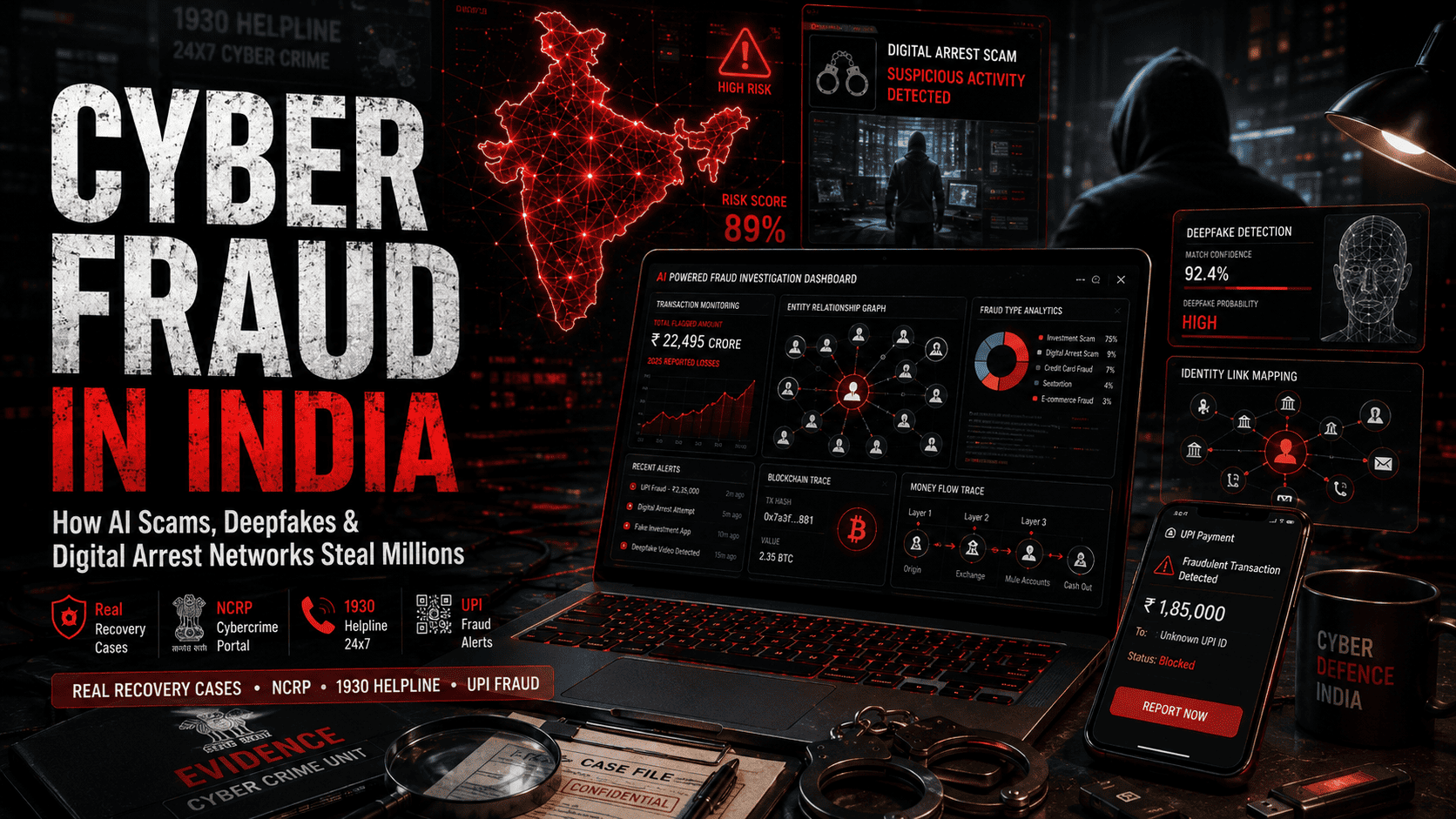
Cyber fraud in India is no longer a problem of poorly written scam emails targeting the uninformed. In 2026, fraudsters use AI-generated deepfakes, fake investment ecosystems, psychological manipulation, and cross-border mule networks to steal money from salaried professionals, retirees, business owners, and financially aware investors alike.
The numbers are staggering. In 2025 alone, Indians lost at least ₹22,495 crore to cyber fraud, with 28.15 lakh cases reported — a 24% increase over the previous year. The national cybercrime helpline 1930 received nearly 3.24 crore calls in 2025, roughly one every second.
Yet behind these headlines are real recovery stories. Victims who acted fast, preserved evidence, and reported through official channels have recovered partial or full amounts — sometimes in hours. This guide documents how those recoveries happened, what made the difference, and how you can protect yourself.
Table of Contents
What Is Cyber Fraud — And Why Is It Rising in India?
Cyber fraud refers to any criminal scheme that uses digital technology to deceive victims into transferring money, sharing credentials, or surrendering financial access. It covers a wide spectrum: UPI scams, fake investment platforms, phishing attacks, business email compromise, remote access fraud, and AI-powered deepfake scams.
India’s rapid digital adoption has created enormous opportunity — and enormous risk. UPI processed over 24,162 crore transactions worth ₹314 lakh crore in FY26, making it the world’s largest real-time payment system. That scale also creates one of the world’s largest attack surfaces for cybercriminals.
| Fraud Type | Share of Total Losses (2025) | Primary Target |
| Investment Schemes | 75–77% | High-return seekers, retail investors |
| Digital Arrest Scams | 8–9% | Elderly, isolated individuals |
| Credit Card Fraud | 7% | Banking customers |
| Sextortion | 4% | Social media users |
| E-commerce Fraud | 3% | Online shoppers |
Investment scams alone account for roughly ₹15,000–17,000 crore in annual losses. Approximately 45% of cyber fraud complaints originate from overseas operations — primarily Cambodia, Myanmar, and Laos — making enforcement complex and cross-border coordination essential.
Real Cyber Fraud Recovery Case Studies from 2025–2026
These cases are drawn from publicly reported police investigations and court records. They show both what went right — and what victims could have done differently.
Case 1: Digital Arrest Scam — ₹24 Crore Lost, ₹5.46 Crore Recovered
What happened: Lakshmi Ramamurthy, a 74-year-old retired teacher in Bengaluru, was contacted in January 2026 by fraudsters posing as CBI and Enforcement Directorate officials. They accused her of money laundering, placed her under a fake “digital arrest” via round-the-clock video surveillance, and over 2.5 months, manipulated her into transferring ₹24 crore across 26 transactions into 23 different accounts linked to 10 banks. The fraudsters operated from a 10×10 foot shop in Gurgaon.
How recovery happened: When Ramamurthy visited her bank to pledge 1 kg of gold for a further ₹3 crore transfer, a vigilant bank manager grew suspicious, questioned her, and immediately alerted police. The Karnataka State Cyber Command traced funds through the National Cyber Crime Reporting Portal (NCRP), froze multiple accounts, and arrested six individuals across Tamil Nadu, Mumbai, Ahmedabad, Delhi, and Bihar. Over ₹5.46 crore was recovered or frozen across two operations — and an additional ₹3 crore loss was prevented entirely.
Key lesson: Bank staff vigilance saved this case. No government agency will ever conduct an investigation over a video call, demand financial “verification,” or ask you to stay silent about an ongoing inquiry. Isolation is the scam’s core weapon — reach out to family or your bank immediately if something feels wrong.
Case 2: Business Email Compromise — ₹2.16 Crore Fully Recovered
What happened: Hackers intercepted email correspondence between Dr. Reddy’s Laboratories and a vendor, created a spoofed email nearly identical to the supplier’s address, and redirected a ₹2.16 crore payment to a fraudulent Bank of Baroda account. The operation was traced to Nigeria.
How recovery happened: When the actual vendor enquired about outstanding dues, Dr. Reddy’s immediately suspected fraud and filed a complaint with the Cyber Crime Police. Police issued a notice to the bank the same day. The account was frozen before any withdrawal occurred. A court order on January 5, 2026 directed full refund — 100% of ₹2.16 crore was returned to the company.
Key lesson: Any change in a vendor’s payment details must be verified through an independent channel — a phone call to a number you already have on file, not a number provided in the email. A single verification call could have caught this before it happened.
Case 3: Cross-Border BEC — ₹3.72 Crore Fully Recovered
What happened: Shivganga Drillers Private Limited, an Indore-based firm, was making a legitimate payment of approximately ₹3.72 crore to a US-based vendor. Cybercriminals intercepted the email thread, impersonated the vendor, and redirected the funds to a JP Morgan Bank account in the United States.
How recovery happened: A second suspicious email requesting the amount be re-sent triggered alarm. The company called the vendor directly, discovered the fraud, and immediately approached the state cyber cell. A complaint was filed on both the NCRP and the IC3 (US FBI’s Internet Crime Complaint Center). Indian authorities contacted JP Morgan, which froze the account. The entire amount was recovered — a rare 100% cross-border recovery.
Key lesson: International recovery is possible when dual jurisdictional complaints are filed immediately. The IC3 filing covered the US side while the NCRP covered India — both were essential to the outcome.
| Source | URL |
|---|---|
| Shunyatax Blog (full case details) | https://shunyatax.in/blogs/news/international-business-email-fraud-rs-3-72-crore-recovered shunyatax+1 |
| Free Press Journal (Indore) | https://www.freepressjournal.in/indore/indore-news-cyber-cell-recovers-372-crore-lost-by-city-company-in-internationalcyber-fraud |
Case 4: Fake Trading App Scam — ₹4.15 Crore Lost, ₹25 Lakh Frozen
What happened: Two Hyderabad investors were recruited through Facebook and Instagram ads into WhatsApp groups where fabricated profit screenshots and fake analyst personas built credibility. The scammers used counterfeit trading apps bearing the names of reputed financial companies, complete with manipulated dashboards showing inflated returns. Small initial withdrawals were processed successfully — a classic “pig butchering” technique — before victims were asked to deposit larger sums under the pretext of “audit clearing” or “IPO share release.” Combined losses: ₹4.15 crore.
How recovery happened: Both victims filed complaints promptly on the NCRP. Coordinated action with banks froze ₹25.10 lakh across the two accounts before further dispersal. Funds will be refunded after court orders.
Key lesson: When a platform allows you to withdraw a small amount early, that is not proof of legitimacy. It is a deliberate trust-building tactic to encourage larger deposits later. No regulated investment platform recruits members through unsolicited WhatsApp groups.
Case 5: Fake Investment Network — ₹24 Lakh Lost, Mule Network Exposed
What happened: A Delhi-based investor was added to a WhatsApp group where admins shared fabricated screenshots showing massive stock trading returns. After transferring around ₹24 lakh across multiple accounts, he was unable to withdraw funds and was continually asked for additional deposits.
How recovery happened: The investor filed a complaint on the NCRP. Delhi Police traced WhatsApp numbers to Cambodia and funds through mule accounts across multiple states, including shell firms “New Journey Overseas Pvt. Ltd.” and “MZ Enterprises.” Investigators froze ₹6.7 lakh and linked the case to more than 60 other NCRP complaints using the same mule accounts. Among those arrested were individuals with B.Tech, MBA, and cybersecurity qualifications.
Key lesson: The same mule accounts are reused across dozens of fraud cases. When you report promptly, you are not only helping yourself — you are potentially enabling police to dismantle an entire network affecting hundreds of other victims.
Case 6: QR Code UPI Scam — The Recovery Playbook
This scenario is among the most common in India: a scammer poses as a buyer or refund-sender, claims you need to “scan a QR code to receive your money,” and once you enter your UPI PIN, money flows out of your account, not into it.
The critical rule: A QR code initiates a payment. It never receives money. No legitimate transaction requires you to enter your PIN to confirm a receipt.
What to do immediately if this happens:
- Dial 1930 within minutes — The helpline triggers the CFCFRMS system, which can freeze the recipient account at the NPCI level before withdrawal occurs.
- Open your UPI app → Transaction History → disputed transaction → Raise a Dispute. Note the reference number.
- Screenshot everything — the scammer’s UPI ID, phone number, any chat messages or marketplace listings.
- File at cybercrime.gov.in (NCRP) under Financial Fraud → UPI. Save your complaint number.
- Call your bank’s fraud helpline and request a temporary UPI block.
The first 30 minutes after a fraudulent UPI transaction is your most powerful window for recovery.
| Source | URL |
|---|---|
| Moneycontrol (recovery steps) | https://www.moneycontrol.com/news/business/personal-finance/scanned-a-fake-upi-qr-code-here-is-how-to-report-the-fraud-and-try-recovering-your-money-13928666.html |
| Intelegal (QR scam guide) | https://www.intelegal.in/blog/upi-qr-code-scams-how-money-disappears-in-seconds-and-how-to-stop-it |
| Original blog source | https://blogs.nahar.om/fraud-cybercrime/upi-frauds-trends-india/ |
Case 7: Deepfake Investment Scam — ₹43 Lakh Lost
What happened: A 57-year-old homemaker in Bengaluru lost ₹43.4 lakh after an AI-generated deepfake video of Union Finance Minister Nirmala Sitharaman was used to promote a fake investment platform as government-endorsed. In a similar pattern, a Hyderabad techie lost ₹3.37 crore through a WhatsApp trading group that used small initial “profits” to encourage escalating deposits under the pretext of “OTC trades and IPO purchases.”
Key lesson: AI-generated videos of public figures endorsing specific investment products are almost certainly fraudulent. No government official promotes trading platforms via video. Before investing in any platform, verify its SEBI registration at sebi.gov.in, check the company’s incorporation documents, and search for independent reviews.
The Common Psychology Behind Every Cyber Fraud
Despite different formats — UPI scams, investment frauds, digital arrests — nearly every cyber fraud exploits the same psychological triggers. Experts summarize this as the GIF triad: Greed, Ignorance, and Fear.
Greed is exploited through promises of guaranteed returns, IPO allotments, and “insider opportunities.” The desire for easy money overrides rational skepticism.
Ignorance is exploited through knowledge gaps — victims don’t know that QR codes can’t receive money, that government agencies don’t conduct video-call arrests, or that collect requests in UPI are payment outflows, not inflows.
Fear is the most powerful weapon. Digital arrest scams use threats of criminal charges, money laundering accusations, and public humiliation to prevent victims from thinking clearly or reaching out to family.
In every case, isolation amplifies vulnerability. Fraudsters insist victims tell no one about the “ongoing investigation.” Breaking that isolation — by calling a family member, a bank manager, or 1930 — is often what saves people.
What Actually Improves Your Chances of Recovery
Based on documented case outcomes, these are the factors that consistently determine whether recovery happens:
1. Reporting within the golden hour. The first 60 minutes after a fraudulent transaction is when the 1930 helpline can request a lien on the beneficiary account before funds are withdrawn or layered. Every hour of delay reduces the probability of recovery significantly.
2. Filing through official channels. The CFCFRMS (Citizen Financial Cyber Fraud Reporting & Management System) connects police, banks, payment providers, and wallets for coordinated action. Filing at 1930 and cybercrime.gov.in simultaneously triggers this system.
3. Preserving digital evidence. Transaction IDs, UPI reference numbers, screenshots of chats, scammer profiles, phone numbers, and bank account details are all essential for investigators. Do not delete anything.
4. Using the RBI Banking Ombudsman. If your bank fails to act on a timely complaint, the RBI Integrated Ombudsman Scheme can order compensation. In one documented case, five banks were collectively ordered to pay ₹1.31 crore to a digital arrest victim for KYC and transaction monitoring lapses.
5. Cross-border dual complaints. For frauds involving overseas accounts, filing with both the NCRP and international bodies like the IC3 (US FBI) has enabled full recovery, as the ₹3.72 crore Indore case demonstrated.
Step-by-Step Recovery Framework
| Step | Action | Time Window |
| 1 | Dial 1930 — Report to cybercrime helpline | Immediately (minutes) |
| 2 | Notify your bank — Request freeze/block | Within 1 hour |
| 3 | File complaint on cybercrime.gov.in (NCRP) | Within 24 hours |
| 4 | Preserve all evidence | Immediately |
| 5 | File FIR at local cyber police station | Within 24–48 hours |
| 6 | Track complaint status via NCRP portal | Ongoing |
| 7 | Escalate to RBI Banking Ombudsman if bank unresponsive | After bank response period |
Why Many Victims Never Recover Their Money
India’s national cyber fraud recovery rate is approximately 6% of chargebacks — a sobering figure. The reasons are predictable:
Delayed reporting is the single biggest cause of failed recovery. By the time most victims realise they have been scammed, the money has moved through three to ten layers of mule accounts, been withdrawn as cash, or converted to cryptocurrency.
Panic and evidence deletion destroy investigations. Embarrassed or distressed victims delete chat histories, uninstall apps, or block profiles — eliminating the digital trail that investigators depend on.
Fake recovery agents add injury to injury. Scammers posing as “cyber fraud recovery specialists” demand upfront fees to retrieve your money. This is always a secondary scam. Legitimate recovery through official channels never requires advance payment.
Assuming recovery is impossible means never filing a complaint — which guarantees that assumption comes true.
Prevention Checklist: How to Protect Yourself
- Never share OTPs, UPI PINs, or passwords with anyone — ever. No bank, government official, or company will ever ask for these.
- Verify URLs carefully before entering banking credentials. Fraudsters use near-identical lookalike domains.
- Never approve an unknown UPI collect request. Always check who is requesting before entering your PIN.
- Never scan a QR code from an unknown person to “receive” money. QR codes only initiate outgoing payments.
- Never install AnyDesk, TeamViewer, or any remote access app at an unknown caller’s request.
- Enable SMS and email transaction alerts on all bank accounts to detect unauthorized activity instantly.
- Verify investment platforms on sebi.gov.in before committing any money. Check company registration.
- Treat unsolicited WhatsApp investment groups as fraudulent by default.
- If a public figure appears to be endorsing a trading platform in a video, assume it is a deepfake.
- If you are told to keep a call secret from family or your bank — end the call immediately. That instruction is the scam.
Frequently Asked Questions
Can victims recover money lost in cyber fraud in India? Yes, partial or full recovery is possible when reported immediately — ideally within 60 minutes. However, the national recovery rate remains around 6% of chargebacks, making prevention far more effective than post-fraud recovery.
What is the 1930 cybercrime helpline? 1930 is India’s national 24×7 cybercrime helpline for reporting financial fraud. Calling it immediately after a fraud triggers the CFCFRMS system to coordinate account freezes across banks. It received 3.24 crore calls in 2025.
How quickly should cyber fraud be reported? Immediately — within minutes of the fraudulent transaction. The first 60 minutes is the “golden hour” when fund freezing is most likely to succeed.
What evidence should I preserve after cyber fraud? Transaction IDs, UPI reference numbers, screenshots of all conversations, scammer phone numbers and UPI IDs, bank account details if known, and any platform or app screenshots.
Are investment scam recoveries possible? Partial recovery is possible when reported quickly and funds are frozen before being layered across accounts. Most investment scam recoveries amount to 10–20% of total losses.
What should I never do after cyber fraud? Never pay anyone claiming to recover your money for an upfront fee. Never delete evidence. Never delay reporting. Never contact the scammer again.
Is digital arrest a real legal process? No. No legitimate government agency — CBI, ED, police, or any court — conducts investigations, arrests, or “verifications” over video calls. Digital arrest is entirely fictional and always a scam.
Conclusion
India’s cyber fraud landscape in 2026 is sophisticated, psychologically calculated, and cross-border in scale. The losses — over ₹22,000 crore in a single year — reflect both the scale of India’s digital economy and the maturity of criminal networks exploiting it.
But the recovery stories documented here carry a consistent message: speed is the decisive variable. The bank manager who asked one extra question saved ₹3 crore. The company that called its vendor before wiring again recovered ₹2.16 crore in full. The investors who filed NCRP complaints within hours had funds frozen before they disappeared.
Prevention remains your strongest protection — understanding that QR codes cannot receive money, that no government conducts video-call arrests, and that guaranteed investment returns do not exist in legitimate markets. These are not complex principles. They are the specific knowledge gaps that fraudsters depend on.
If you or someone you know is affected by cyber fraud, dial 1930 immediately. File a complaint at cybercrime.gov.in. Notify your bank. Preserve every piece of evidence. Do not let shame, panic, or the assumption that “the money is gone” delay you — in cyber fraud, every minute genuinely counts.
This content is for educational and awareness purposes only. It does not constitute legal or financial advice. Cyber fraud investigation outcomes vary based on facts, reporting speed, jurisdiction, and applicable law. All case details are based on publicly reported police investigations as of 2025–2026. Readers should consult qualified legal professionals for situation-specific advice.