
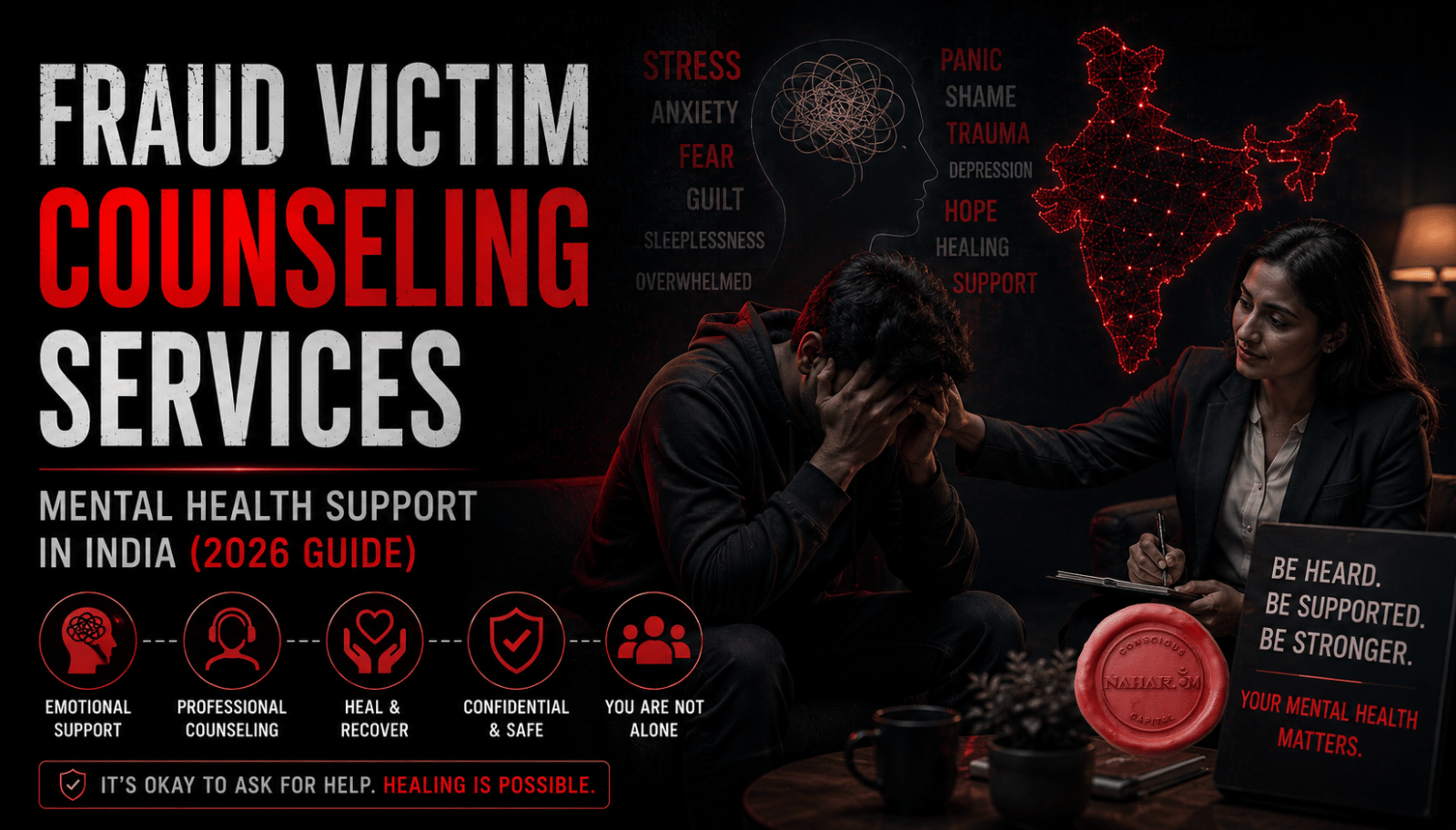
You did everything right. You worked hard for your money. You were careful. And yet — somehow — a scammer found a way in. Now the money is gone, and you are left dealing with something nobody prepared you for: the emotional aftermath.
Financial fraud does not just empty your bank account. It shakes your sense of safety, your trust in others, and your confidence in yourself. This guide is written for you — with honesty, without judgment, and with genuine care for your recovery.
Yes — fraud absolutely affects mental health. Losing money to a scam, cybercrime, or investment fraud can trigger anxiety, shame, depression, sleep problems, and lasting distrust. These reactions are normal and do not mean you are weak. Counseling and emotional support genuinely help fraud victims process trauma and rebuild confidence. In India, options include private therapists, online counseling platforms, and helplines. You do not have to navigate recovery alone.
Table of Contents
Quick Summary
| Question | Answer |
| Can fraud cause emotional trauma? | Yes — financial loss combined with betrayal creates real psychological distress |
| Is counseling helpful? | Yes — it helps process shame, anxiety, and rebuild confidence |
| Who should seek support? | Anyone experiencing persistent emotional distress after fraud |
| Common emotional effects | Shame, anxiety, anger, depression, sleep disturbance, social withdrawal |
| Support options available | Private therapists, online platforms, helplines, support groups, EAPs |
| Family involvement | Essential — supportive family significantly improves recovery outcomes |
| Professional help needed? | When distress persists beyond a few weeks or affects daily functioning |
Understanding the Emotional Impact of Fraud
Most people think of fraud as a money problem. It is much more than that.
When you are defrauded, you lose more than rupees. You lose your sense of security — the feeling that you can navigate the world safely. You lose trust — in strangers, sometimes in people you know, occasionally even in yourself. And you lose something harder to name: the confidence that your judgment can be relied upon.
This combination of losses is why fraud victims often describe the experience as feeling violated — similar in emotional texture to other forms of betrayal, even though no physical harm occurred.
The psychological impact is compounded by several unique features of financial fraud:
- The loss is often invisible to others, making it hard to explain or seek sympathy
- Society frequently implies victims should have “known better,” adding shame to injury
- The financial consequences — reduced savings, disrupted plans, unpaid bills — continue long after the fraud itself
- For many victims, particularly in India, the lost money represented years of savings or family security
Understanding that your emotional reaction is a normal human response to an abnormal violation is the first step toward healing.
Why Fraud Victims Blame Themselves
Shame and self-blame are the most common — and most damaging — emotional responses to fraud. Victims frequently ask themselves: “How could I have been so stupid?” “Why did I trust them?” “What will my family think?”
This self-criticism is deeply unfair and factually wrong. Here is why.
Scammers are professionals. They have spent years — often working in organized criminal operations — perfecting techniques to bypass exactly the kinds of mental defenses most people rely on. They study human psychology. They test their scripts on thousands of people. They know which triggers create trust, which create urgency, and which lower resistance.
Research in behavioral psychology consistently shows that fraud victims are not disproportionately naive, uneducated, or careless. Studies of large-scale fraud incidents reveal victims across every demographic — PhDs, senior executives, experienced investors, and cybersecurity professionals among them.
What scammers exploit is not stupidity. They exploit normal human qualities:
- Trust — the healthy default that allows society to function
- Optimism — the belief that good opportunities exist
- Responsiveness to authority — a deeply ingrained social behavior
- Fear of loss — a universal human motivator
- Kindness — the impulse to help someone who appears to need it
If you were defrauded, a professional criminal targeted and manipulated you. That is not a character flaw. It is a crime that was committed against you.
Common Emotional Reactions After Fraud
| Emotional Reaction | How It Feels | Why It Happens |
| Shock | Numbness, disbelief, difficulty processing | The brain’s initial protective response to overwhelming news |
| Anger | Rage at the fraudster, at yourself, at the system | Natural response to injustice and violation |
| Shame | Deep embarrassment, wanting to hide | Social stigma around being “tricked” |
| Guilt | Feeling responsible for the loss | Self-blame, especially if family funds were involved |
| Anxiety | Constant worry, hypervigilance about finances | Loss of financial security triggers ongoing threat response |
| Depression | Low mood, hopelessness, loss of enjoyment | Grief over lost money, plans, and trust |
| Sleep disturbance | Insomnia, nightmares, exhaustion | Anxiety and rumination disrupt sleep cycles |
| Panic attacks | Sudden intense fear, racing heart, breathlessness | Triggered by financial reminders or stressful situations |
| Loss of confidence | Doubting all decisions | Shaken trust in one’s own judgment |
| Social withdrawal | Avoiding family, friends, social situations | Shame and fear of judgment |
| Hypervigilance | Suspicion of everyone, constant checking | Natural response after betrayal of trust |
All of these reactions are understandable. None of them are permanent with proper support.
The Psychology of Scams: How Fraudsters Manipulate Normal People
Understanding how you were manipulated is not about excusing what happened — it is about releasing the self-blame that slows recovery.
Social engineering is the technical term for what scammers do. They engineer social situations to produce the responses they want. Their tools include:
Trust building: Fraudsters invest time in establishing credibility before asking for anything. They may spend days, weeks, or months building a relationship — as an investment advisor, romantic interest, employer, or helpful stranger — before the trap is set. By the time money is requested, the victim has a genuine emotional investment in the relationship.
Urgency and scarcity: “This investment opportunity closes today.” “Your account will be suspended in two hours.” Artificial urgency bypasses deliberate thinking. The brain shifts into reactive mode, and careful evaluation is overridden by the need to act quickly.
Authority impersonation: Fake police officers, bank officials, RBI representatives, IT department officers. Authority figures trigger compliance instincts that are deeply embedded in social behavior. People are conditioned to cooperate with authority.
Fear tactics: Threats of legal action, arrest, account freezing, or family notification create terror that shuts down rational thinking entirely. Victims act to make the threat stop.
Reciprocity: The fraudster “gives” something first — information, a small profit, emotional support — triggering the human impulse to give back.
Isolation: Sophisticated fraudsters encourage victims not to discuss the “opportunity” with family or friends, removing the social safety net that might otherwise catch the fraud.
None of these tactics work because victims are foolish. They work because they target the features of human psychology that make us good, trusting, functional members of society.
Signs That a Fraud Victim May Need Professional Help
Some emotional distress after fraud is expected and will ease naturally with time, social support, and practical action. But some situations call for professional guidance.
Consider seeking professional support if you experience:
- Anxiety or worry that does not ease after several weeks
- Panic attacks or difficulty breathing
- Persistent sleep problems — inability to fall asleep, staying asleep, or early waking
- Loss of appetite or significant changes in eating
- Inability to concentrate at work or complete daily tasks
- Withdrawal from family, friends, and social life
- Feelings of hopelessness or worthlessness
- Intrusive thoughts about the fraud that you cannot control
- Physical symptoms — headaches, chest tightness, stomach problems — without medical cause
- Thoughts of harming yourself
If you are experiencing thoughts of self-harm, please reach out to iCall at 9152987821 or Vandrevala Foundation at 1860-2662-345, available 24/7. You do not have to manage this alone.
How Counseling Helps Fraud Victims
Counseling is not about being “crazy” or unable to cope. It is about having a skilled professional help you navigate an experience that is genuinely difficult.
Emotional processing: A counselor provides a safe, non-judgmental space to express what you are feeling — the anger, the shame, the grief — without fear of burdening family members or being dismissed.
Releasing self-blame: Therapists trained in fraud trauma specifically help victims understand the psychology of manipulation. This understanding is often transformative in reducing shame and guilt.
Stress and anxiety management: Practical tools — breathing techniques, cognitive reframing, mindfulness — help manage the physical and emotional symptoms of anxiety.
Rebuilding confidence: Graduated exercises and supportive therapy help victims regain trust in their own decision-making, which is often severely shaken after fraud.
Managing fear of future fraud: Hypervigilance and blanket distrust can be as disabling as the fraud itself. Counseling helps calibrate appropriate caution without paralysing fear.
Family communication: Therapists can facilitate difficult conversations with family members who may be angry, blaming, or struggling to understand the victim’s experience.
Types of Counseling Services Available in India
| Type | Description | Best For | Accessibility |
| Individual therapy | One-on-one sessions with a psychologist or counselor | Processing trauma, shame, anxiety | In-person or online |
| Online therapy platforms | Video or chat-based therapy via apps | Those who prefer privacy or lack local access | High — nationwide |
| Clinical psychologists | Qualified professionals for complex trauma | Severe anxiety, depression, PTSD symptoms | Variable by city |
| Psychiatric support | Medical doctors for medication if needed | When depression or anxiety is severe | Referral usually needed |
| Support groups | Peer communities of fraud victims | Reducing isolation, shared experience | Online increasingly available |
| Crisis counseling helplines | Immediate telephone support | Acute distress, immediate crisis | 24/7 availability |
| Employee Assistance Programs | Employer-provided confidential counseling | Working professionals | Through employer |
Online platforms operating fraud victims counselling in India
| Service | Website | Support Details |
|---|---|---|
| iCall (TISS) | iCALL Helpline | Free psychosocial counseling via phone, email, and chat. Helpline: 9152987821. Operated by the Tata Institute of Social Sciences (TISS). (iCALL Helpline) |
| Vandrevala Foundation | Vandrevala Foundation Mental Health Support | Free 24×7 mental health counseling. Call/WhatsApp: +91 9999 666 555. (Vandrevala Foundation) |
| Fortis Mental Health Helpline | Fortis Healthcare | National mental health helpline: +91 8376804102 (24×7 multilingual support). (CSR India) |
| YourDOST | YourDOST Emotional Wellness Platform | Online counseling, therapy, emotional wellness coaching, and expert consultations. (YourDOST) |
| Practo Mental Health | Practo Mental Health Specialists | Online and in-person consultations with psychologists, psychiatrists, and therapists across India. |
| InnerHour (Amaha) | Amaha (formerly InnerHour) | Mental wellness app offering therapy, self-care programs, psychiatric consultations, and emotional support resources. |
How Family Members Can Support a Fraud Victim
Family support is one of the most important factors in recovery. It can also, if handled poorly, be one of the most damaging.
What helps:
- Listen without immediately problem-solving. The victim needs to feel heard before they need solutions.
- Avoid blame, even if you feel frustrated. Phrases like “How could you not see this coming?” cause lasting harm.
- Express support clearly. “This was not your fault. We will get through this together.”
- Help with practical tasks. Filing complaints, contacting banks, gathering documents — practical help relieves overwhelming burden.
- Respect their timeline. Recovery is not linear. Do not push for “being over it.”
- Encourage professional support without forcing it. Suggest counseling as a resource, not a judgment.
- Monitor quietly for serious symptoms. If you notice signs of severe depression or withdrawal, gently encourage professional help.
What hurts:
- Repeated references to “how much money was lost”
- Comparing them unfavourably to others who “would never have fallen for this”
- Sharing the incident with others without permission
- Withdrawing affection or support out of anger
- Demanding immediate emotional recovery
25 Practical Coping Strategies After Fraud
- Report the fraud immediately — taking action reduces helplessness.
- Allow yourself to feel the emotions without judgment — suppression extends recovery.
- Tell at least one trusted person — isolation amplifies shame.
- Separate the financial problem from your identity — losing money does not make you a lesser person.
- Limit searching online about the scam — excessive research often worsens anxiety.
- Maintain your daily routine as much as possible — structure provides stability.
- Exercise, even lightly — physical movement genuinely reduces anxiety and improves mood.
- Sleep hygiene practices — regular sleep times, dark room, no screens before bed.
- Eat regularly even when appetite is low — physical care supports mental recovery.
- Keep a brief daily journal — externalizing thoughts reduces rumination.
- Set one small financial action per day — rebuilding a sense of control is therapeutic.
- Contact a fraud victim helpline — trained responders understand what you are experiencing.
- Avoid making major financial decisions while in acute distress — wait until stability returns.
- Be honest with your employer if work performance is affected — EAPs may be available.
- Seek online peer communities of fraud survivors — shared experience reduces isolation.
- Limit alcohol — it worsens anxiety and depression despite feeling temporarily relieving.
- Practice one grounding technique daily — five deep slow breaths, naming five things you can see.
- Focus on what is within your control rather than what is not.
- Give yourself a defined “worry window” — 15 minutes a day to think about the fraud, then consciously redirect.
- Remember previous difficulties you have overcome — resilience has worked for you before.
- Consider speaking to a financial counselor about rebuilding after the loss.
- Reconnect with activities that gave you pleasure before the fraud.
- Accept help from others — this is not weakness; it is intelligent use of available resources.
- Remind yourself daily that fraudsters are criminals and you are a victim of crime.
- Set a recovery timeline goal — not rigid, but directional — “In three months I want to feel X.”
Special Section: Senior Citizens as Fraud Victims
Older adults face a uniquely difficult emotional experience after fraud. Many have spent decades building their savings. Losing a significant portion to fraud can feel like the destruction of a life’s work.
Compounding this, senior citizens often face:
- Greater shame about “being fooled,” especially in cultures where elders are expected to be wise
- Less familiarity with digital fraud reporting processes
- Greater dependence on lost funds for retirement or medical needs
- Fear of being seen as incapable of managing their own affairs
- Isolation that makes both the fraud and the recovery harder
Family members of senior fraud victims should approach the situation with exceptional gentleness. Blame — even implied — can be devastating. Practical support with reporting and documentation, combined with emotional reassurance, is what is most needed.
Professional counseling specifically experienced with older adults is available through geriatric care specialists and organizations like HelpAge India, which also provides some support services.
Common Mistakes Fraud Victims Make During Emotional Recovery
- Isolating completely — shame drives withdrawal that worsens depression
- Refusing to tell anyone — silence compounds the burden
- Ruminating constantly — replaying the fraud on a mental loop extends trauma
- Chasing losses — attempting risky decisions to “get the money back” risks further loss
- Trusting recovery scammers — fraudsters specifically target fresh victims; any “recovery service” charging upfront fees is another scam
- Ignoring physical symptoms — headaches, chest tightness, insomnia all need attention
- Withdrawing from work without communication — financial strain worsens without income
- Blaming a family member who introduced them to a scheme — this destroys relationships
- Expecting instant emotional recovery — healing takes time; impatience creates additional distress
- Excessive alcohol or substance use as coping — creates secondary problems
- Making major financial decisions in acute distress — often leads to further losses
- Avoiding all future financial decisions — paralysis is not safety
- Refusing professional help due to stigma — counseling significantly improves outcomes
- Comparing themselves to “smarter” people — nobody is immune to professional manipulation
- Excessive online research into the scam — often worsens anxiety without improving outcomes
- Not reporting because of shame — reporting is therapeutic and practically valuable
- Assuming recovery is linear — setbacks during healing are normal, not failure
- Dismissing their own trauma — “I should be over this by now” — recovery has no fixed timeline
- Only focusing on financial recovery while ignoring emotional recovery
- Not asking for help from employer — EAPs and supportive managers can provide significant relief
Case Studies
Case Study 1: UPI Fraud Victim
Sunita, a 38-year-old teacher in Jaipur, received a call from someone claiming to be from her bank. She was asked to verify her account via a link. Within minutes, ₹85,000 was transferred from her account. Beyond the financial shock, Sunita struggled with profound shame. She had not told her husband about a portion of those savings. The secret compounded her distress. She withdrew from colleagues and could not sleep for weeks.
After a month she confided in a friend who gently encouraged her to speak to a counselor through an online platform. Over eight sessions, she worked through the shame and the fear of her husband’s reaction. She eventually told him. His response was supportive. She filed a cybercrime complaint and partially recovered funds.
Lesson: Shame that is carried alone grows. Sharing it begins to diminish it.
Case Study 2: Investment Scam Victim
Rakesh, a 45-year-old engineer in Pune, invested ₹6 lakh in a trading platform over four months based on a recommendation in a Telegram group. When the platform disappeared, he lost not just money but his family’s planned home renovation funds. His anger — at the fraudsters and at himself — was overwhelming. He became irritable with his children and distant from his wife.
His company’s Employee Assistance Program connected him with a counselor. Over several sessions, he worked through the anger and understood the psychological manipulation he had experienced. He also engaged a cybercrime lawyer.
Lesson: Anger needs a safe outlet. Counseling provided that, protecting his family relationships during an extremely stressful period.
Case Study 3: Crypto Scam Victim
Arun, a 29-year-old IT professional in Bengaluru, lost ₹2.2 lakh to a pig butchering scam. He was particularly distressed because he prided himself on being technologically sophisticated. The shame of being deceived despite his knowledge was acute. He told no one and began to develop anxiety attacks before opening his laptop each morning.
He eventually found an online support forum for crypto scam victims. Connecting with others who had similar experiences began to reduce his shame. He then sought individual therapy. Within three months his anxiety attacks had significantly reduced.
Lesson: Peer community is uniquely valuable — there is something irreplaceable about being understood by someone who has been through the same experience.
Expert Analysis: Why Fraud Is Both a Financial and Psychological Crisis
The mental health field increasingly recognizes fraud and financial crime as potential sources of genuine psychological trauma.
What makes fraud trauma distinct is the combination of financial loss with betrayal. Financial loss alone — even severe loss through business failure or investment decline — is psychologically different from fraud. Fraud adds a human agent who deliberately deceived you. This activates the same neural pathways as interpersonal betrayal, which research shows produces stronger and longer-lasting psychological distress than impersonal losses.
For many Indian victims, the distress is compounded by cultural factors. In a culture where financial prudence is deeply valued, where family savings carry significant emotional weight, and where community reputation is important, financial fraud carries layers of shame beyond the economic loss itself.
The good news, documented in psychological research and clinical practice, is that post-fraud trauma is treatable. With appropriate support — therapy, peer connection, practical action, and time — the vast majority of fraud victims do recover their emotional equilibrium. The most important variables are seeking support rather than suffering in silence, and being patient with a recovery process that is rarely linear.
Frequently Asked Questions
Q1. Can fraud really cause the same trauma as other serious life events? Yes. Psychological research confirms that financial fraud can trigger genuine trauma responses including anxiety, depression, PTSD symptoms, and significant disruption to daily functioning. The combination of financial loss and deliberate human betrayal is a powerful trauma mechanism. The fact that no physical harm occurred does not minimize the psychological impact. Many fraud victims report that the emotional aftermath is harder to deal with than the financial loss itself. Taking this seriously — rather than dismissing it as “just money” — is important for both victims and those who support them.
Q2. How do I stop blaming myself after being scammed? Self-blame is an almost universal initial response to fraud, and it is almost always unjustified. Scammers are trained professionals who spend enormous effort perfecting manipulation techniques. They succeed across every demographic — including highly educated, financially experienced, and technically sophisticated people. Understanding the specific manipulation techniques used against you — urgency, authority, trust-building, fear — helps transform the experience from “I was stupid” to “I was targeted by a professional criminal.” Therapy specifically accelerates this shift. Give yourself the same compassion you would offer a friend in this situation.
Q3. What should I do if my family is blaming me? Family blame is painful and unfortunately common. It often comes from the family member’s own fear and distress rather than genuine cruelty. If possible, gently share resources about how fraud actually works — particularly how professional manipulation bypasses normal defenses. If blame continues and is affecting your recovery, a family counseling session with a therapist can help facilitate more supportive communication. In the meantime, seek emotional support from trusted friends, support groups, or a counselor who can provide the non-judgmental support your family is not currently able to offer.
Q4. How long does emotional recovery from fraud take? There is no fixed timeline. Many people notice significant improvement within two to three months, particularly with social support and professional help. Others take longer, especially when the financial impact is severe or ongoing. Recovery is rarely linear — there are typically good days and difficult days, with gradually more of the former over time. If intense distress is still significantly impacting daily life after four to six weeks, seeking professional support is recommended. The presence of a counselor or therapist does not mean recovery is delayed — it typically accelerates it.
Q5. Are there free mental health resources for fraud victims in India? Yes. iCall (9152987821) provides professional counseling support on a sliding-scale basis. Vandrevala Foundation (1860-2662-345) offers free 24/7 crisis support. The Fortis Mental Health Helpline (8376804102) is also available. Government hospitals with psychiatry departments offer free or subsidized services. Online communities and peer support groups for fraud victims are free and increasingly accessible. Your employer’s Employee Assistance Program, if available, typically provides free confidential counseling sessions.
Conclusion
Fraud is a crime. What happened to you was not a moral failing — it was a deliberate criminal act committed against you by someone who studied how to bypass your defenses.
The financial damage is real and deserves practical action. The emotional damage is equally real and deserves care and support.
Your immediate action plan:
- Tell one trusted person what happened — ending the silence is the first step
- File a report at cybercrime.gov.in and call 1930 for financial fraud
- Contact one of India’s free mental health helplines if distress is acute
- Give yourself explicit permission to grieve, be angry, and feel whatever you feel
- Seek professional counseling if symptoms persist beyond a few weeks
- Connect with peer communities of survivors — you are not alone in this
Recovery from fraud is possible. Trust can be rebuilt — carefully, selectively, and over time. Confidence in your own judgment returns. Financial rebuilding, while slow, is achievable.
You survived something genuinely difficult. The path forward exists, and support is available to help you walk it.
Disclaimer: This article is for educational and informational purposes only. It does not constitute medical or psychological advice. If you are experiencing significant mental health symptoms, please consult a qualified mental health professional. If you are in crisis, please contact a helpline immediately.