
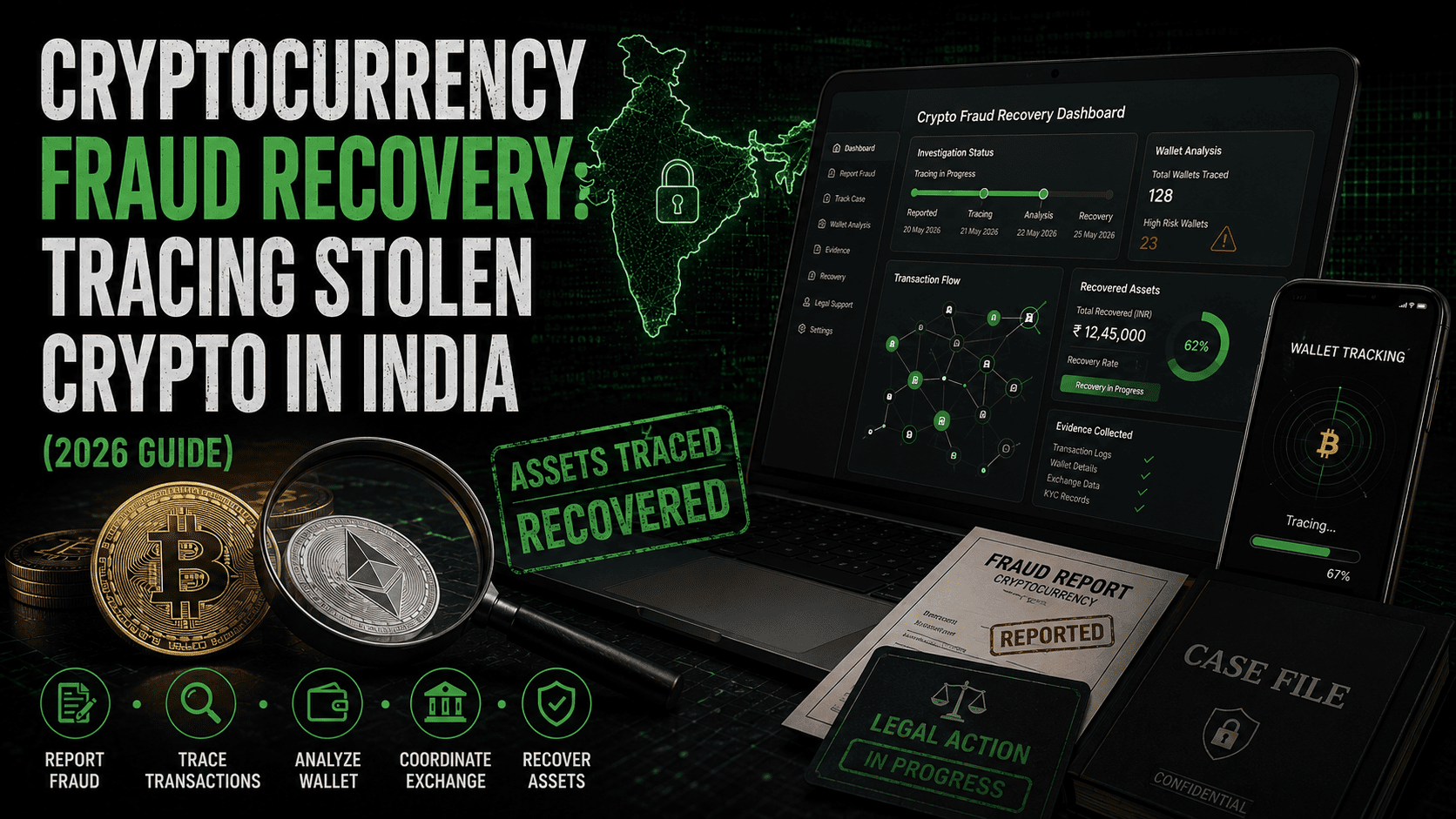
Losing money to a cryptocurrency scam is devastating where you might be thinking to find a cryptocurrency fraud recovery guide the next day.
You may have invested your savings into what looked like a legitimate opportunity, only to find your funds vanished overnight. The good news is that cryptocurrency is not as untraceable as scammers want you to believe. The bad news is that recovery is complex, time-sensitive, and never guaranteed.
This guide is written specifically for Indian crypto fraud victims. It covers everything — from what to do in the first hour after a scam to the legal remedies available under Indian law.
Table of Contents
Immediate Answer: Can Stolen Crypto Be Recovered?
Yes, stolen cryptocurrency can sometimes be recovered — but it depends on how quickly you act and how the fraud occurred.
Blockchain transactions are permanent and irreversible on their own. Nobody can simply “undo” a transfer. However, crypto is not anonymous — every transaction is recorded permanently on a public ledger. Blockchain investigators can trace stolen funds across wallets, identify the exchanges where funds landed, and work with exchanges to freeze assets before they are withdrawn.
Recovery is possible in many cases. It is not guaranteed in all cases.
Quick Summary Table
| Factor | Reality |
| Can Crypto Be Traced? | Yes — all transactions are permanently recorded on public blockchains |
| Can Transactions Be Reversed? | No — blockchain transactions are irreversible by design |
| Can Assets Be Frozen? | Yes — if funds reach a KYC-compliant exchange and a legal request is made in time |
| Recovery Success Factors | Speed of reporting, documentation quality, exchange cooperation, wallet traceability |
| Best First Step | Preserve all evidence immediately and file a complaint at cybercrime.gov.in |
| Reporting Authorities | Cyber Crime Portal, State Cyber Cells, ED, EOW |
| Recovery Time | Weeks to years depending on complexity |
| Chances of Success | Moderate if reported early; low if funds are moved through mixers or offshore exchanges |
What Is Cryptocurrency Fraud?
Cryptocurrency fraud is any deliberate deception that results in a victim losing digital assets or money invested in digital assets. It differs fundamentally from market losses.
If you invested in Bitcoin and its price fell, that is a market loss. Nobody defrauded you. But if someone created a fake trading platform, promised fixed returns, showed you fabricated profit statements, and then disappeared with your funds — that is fraud.
Fraudsters are drawn to crypto for several reasons:
- Transactions are fast and cross borders instantly
- Many victims lack technical knowledge
- Traditional banking fraud controls do not apply
- Reversing transactions is impossible without exchange cooperation
- Anonymity tools like mixers and privacy coins exist
The distinction between market loss and fraud loss matters enormously when approaching recovery and legal action.
Why Cryptocurrency Scams Are Increasing in India
India is one of the fastest-growing crypto markets in the world. With growth comes risk.
Several factors are driving the surge in crypto fraud in India:
- Rising adoption with low awareness: Millions of new investors entered the crypto market during 2020–2023 without adequate knowledge of how it works or how to identify scams.
- High-return expectations: Many Indian retail investors are attracted by promises of extraordinary returns, making them vulnerable to Ponzi and investment scams.
- Sophisticated social engineering: Fraudsters now use AI-generated personas, deepfake videos of celebrities, and professional-looking websites to build trust.
- Cross-border operations: Most large crypto fraud networks operate from Southeast Asia, Eastern Europe, and other jurisdictions where Indian law has limited reach.
- Telegram and WhatsApp penetration: India has hundreds of millions of messaging app users. Fraudsters exploit these platforms to recruit victims through fake investment groups.
- Limited regulatory clarity: India’s evolving regulatory environment creates confusion that fraudsters exploit.
Cybercrime complaints in India crossed 15 lakh (1.5 million) in 2023. Financial fraud accounts for the majority. Crypto-related fraud is among the fastest-growing subcategories.
Types of Cryptocurrency Frauds in India
| Scam Type | How It Works | Warning Signs | Recovery Challenges |
| Fake Investment Platforms | Fraudulent websites mimic legitimate exchanges, show fake profits, then disappear | Guaranteed returns, no verifiable registration, pressure to invest more | Offshore servers, no KYC on platform |
| Pig Butchering Scams | Fraudster builds relationship over weeks, introduces “profitable trading platform,” victim deposits heavily, platform vanishes | Romantic interest from stranger who mentions crypto | Funds moved rapidly through multiple wallets |
| Ponzi Schemes | Early investors paid using new investor funds; collapses when recruitment slows | Fixed daily/weekly returns, referral bonuses | Promoters often arrested but funds already spent |
| Wallet Phishing | Fake websites or apps steal private keys or seed phrases | Requests for seed phrase, suspicious links | Once private key is stolen, wallet is fully compromised |
| Fake Exchanges | Fraudulent exchange allows deposits but blocks withdrawals | Unknown exchange, no regulatory registration, only allows deposits | No KYC records, offshore hosted |
| Rug Pulls | Developers abandon crypto project after raising funds | Anonymous team, no audits, unrealistic roadmap | Developers anonymous, funds laundered quickly |
| Recovery Scams | Fraudsters pose as recovery experts, charge advance fees, deliver nothing | Upfront fees, guaranteed recovery promises | Compounds existing loss |
| Impersonation Scams | Fraudsters pose as celebrities, government officials, or exchange support | Unsolicited DMs, pressure to act immediately | Fake identities, overseas operators |
| Telegram Investment Groups | Groups simulate successful traders, lure victims into fake platforms | Strangers adding you to investment channels | Untraceable admins, offshore platforms |
| WhatsApp Investment Schemes | Similar to Telegram, often run by local operators | Friends or family recruited as unwitting promoters | Local operators sometimes apprehensible |
| Romance Scams | Online romantic relationship exploited to push crypto investment | Partner met only online, quickly introduces crypto | Emotional manipulation delays reporting |
| AI-Generated Scams | Deepfake videos of celebrities endorse fake platforms | Celebrity appears to promote crypto on social media | AI tools available globally, hard to attribute |
Can Stolen Cryptocurrency Really Be Traced?
The most dangerous myth in crypto crime is that Bitcoin and other cryptocurrencies are untraceable. They are not.
Think of a blockchain like a giant public spreadsheet. Every single transaction ever made is recorded. Every wallet address is visible. Every transfer between wallets is logged permanently. Anyone can look at this spreadsheet — it is public.
The confusion arises because wallet addresses are strings of random characters, not names. When a thief moves your Bitcoin, the transaction shows wallet address A sending funds to wallet address B. The blockchain does not automatically reveal who owns wallet B.
But blockchain investigators can connect those dots.
Here is a simple analogy. Imagine a highway with cameras at every point. Cars move freely. Nobody stops you. But every vehicle, every license plate, every movement is recorded. If investigators want to find a car, they can trace exactly where it went — from the crime scene to the destination. The challenge is identifying who was driving. That is where exchange KYC data becomes critical.
Blockchain operates the same way. Every transaction is the camera footage. Exchange KYC records are the DMV database that links plates to names.
Currencies like Monero are specifically designed to obscure this trail, which is why they are preferred by serious criminals. Bitcoin, Ethereum, BNB, USDT, and most mainstream coins are fully traceable.
How Blockchain Investigators Trace Stolen Crypto
Professional blockchain investigation follows a structured process. Here is how it works:
Step 1: Wallet Analysis
The investigator starts with the victim’s wallet or the destination wallet where funds were sent. Using blockchain explorers, they pull the complete transaction history — every incoming and outgoing transfer linked to that address.
Step 2: Transaction Mapping
Each outgoing transaction from the fraudster’s wallet is tracked. Investigators follow the money as it moves from wallet to wallet. This creates a transaction map showing every hop funds made after leaving the victim.
Step 3: Address Clustering
Most fraudsters do not use a single wallet. They spread funds across dozens of addresses to confuse trackers. Blockchain analytics tools use address clustering — a technique that identifies wallets controlled by the same entity based on transaction patterns, timing, and shared inputs.
Step 4: Exchange Identification
Eventually, stolen funds usually reach an exchange. This is where fraudsters convert crypto to cash. Blockchain analytics tools maintain databases of exchange wallet addresses. When traced funds enter a known exchange wallet cluster, investigators can identify which exchange holds the assets.
Step 5: KYC Identification
Once an exchange is identified, investigators send a formal legal request — either directly or through law enforcement — to obtain the KYC (Know Your Customer) data linked to the receiving wallet. This can reveal the fraudster’s name, identity documents, phone number, email, and IP address.
Step 6: Asset Freezing
If funds are still in the exchange wallet and have not been withdrawn, investigators can request the exchange to freeze the assets pending legal proceedings. Indian law enforcement can issue formal requests to exchanges, and most major exchanges cooperate with court orders.
Step 7: Recovery Process
Recovery of frozen funds typically requires a court order directing the exchange to return funds to the victim or transfer them to a government account pending trial. This is the most legally complex and time-consuming phase.
Blockchain Investigation Process Flow
| Stage | Action | Tools Used | Output |
| 1. Wallet Analysis | Examine victim wallet and fraudster destination | Blockchain explorers | Transaction history |
| 2. Transaction Mapping | Follow fund movements hop by hop | Analytics platforms | Fund flow diagram |
| 3. Address Clustering | Identify related wallets | Clustering algorithms | Wallet network map |
| 4. Exchange Identification | Match wallets to known exchanges | Exchange wallet databases | Exchange name identified |
| 5. KYC Request | Legal request to exchange | Court order / LE request | Fraudster identity |
| 6. Asset Freeze | Request exchange to freeze funds | Legal notice / court order | Assets frozen |
| 7. Recovery | Court-directed fund transfer | Judicial process | Funds returned |
Step-by-Step Guide: What To Do Immediately After a Crypto Scam
Time is everything. The faster you act, the better your chances.
Immediate Action Checklist
- Stop all further transfers immediately. Do not send any more money regardless of what the fraudster tells you. Do not believe promises that “one more deposit” will unlock your withdrawal.
- Do not delete anything. Every chat message, email, screenshot, and call record is evidence. Preserve everything on multiple devices.
- Save all transaction hashes (TXIDs). Every blockchain transaction has a unique Transaction ID. Save these immediately. They are the starting point for any investigation.
- Capture screenshots of the platform. Screenshot every page of the fraudulent website or app, including your account balance, transaction history, and withdrawal error messages.
- Record all wallet addresses involved. Note the wallet addresses you sent funds to. These are the starting point for blockchain tracing.
- Save all communication. Export chat histories from WhatsApp, Telegram, email, and any other platform used by the fraudster.
- Note payment details. Record any bank accounts, UPI IDs, or payment gateway details used to fund your crypto account.
- Contact the exchange you used to send funds. If you transferred crypto from a legitimate Indian exchange like WazirX, CoinDCX, or Zebpay, contact their support immediately and explain the situation. Ask them to flag the destination address.
- File a complaint at cybercrime.gov.in. India’s National Cyber Crime Reporting Portal allows victims to file complaints online. File immediately with all available details.
- Register an FIR. Visit your nearest police station and file an FIR under relevant sections. Carry all documentation. Ask for a copy of the FIR.
Printable Evidence Preservation Checklist
| Evidence Type | Where to Find It | Priority |
| Transaction ID (TXID) | Your exchange or wallet app | Critical |
| Fraudster wallet address | Transaction confirmation | Critical |
| Platform screenshots | Browser / app screenshots | Critical |
| Chat history exports | WhatsApp, Telegram, email | Critical |
| Bank/UPI payment receipts | Bank app, payment gateway | Critical |
| Platform URL | Browser address bar | High |
| Domain registration info | WHOIS lookup | High |
| Social media profiles of fraudster | Screenshot before deletion | High |
| Referral details | Who introduced you to the scheme | Medium |
| Witness contacts | Others who invested | Medium |
Which Authorities Handle Cryptocurrency Fraud in India?
| Authority | Role | How to Approach |
| National Cyber Crime Reporting Portal (cybercrime.gov.in) | Central online complaint filing for all cybercrime including crypto fraud | File complaint online; 24/7 accessible |
| State Cyber Crime Cells | Investigate cyber fraud including crypto cases; coordinate with national portal | Contact your state’s cyber crime unit directly |
| Local Police / FIR | Register formal criminal complaint; triggers investigation process | Visit police station with all documentation |
| Enforcement Directorate (ED) | Investigates money laundering, foreign exchange violations, proceeds of crime | Relevant when large amounts are involved or cross-border fraud |
| Economic Offences Wing (EOW) | State-level investigation of financial fraud and Ponzi schemes | Relevant for organized investment fraud |
| Financial Intelligence Unit India (FIU-IND) | Receives reports of suspicious transactions from exchanges | Exchanges report to FIU; victims can provide supporting information |
| SEBI | Limited jurisdiction over crypto, but relevant if scheme involves securities fraud | Complaint if fraud involves securities misrepresentation |
Important: Always file at the Cyber Crime Portal AND register a local FIR. Both are necessary. The portal ensures national-level tracking. The FIR triggers a formal police investigation.
How Indian Law Treats Cryptocurrency Fraud
Indian law does not have a single dedicated cryptocurrency statute, but several laws apply to crypto fraud:
Information Technology Act, 2000
- Section 43: Unauthorized access and damage to computer systems
- Section 66: Computer-related offences including fraud
- Section 66C: Identity theft
- Section 66D: Cheating by personation using computer resources
Indian Penal Code (now Bharatiya Nyaya Sanhita, 2023)
- Section 420 (IPC) / corresponding BNS provisions: Cheating and dishonestly inducing delivery of property
- Section 406: Criminal breach of trust
- Section 120B: Criminal conspiracy
Prevention of Money Laundering Act (PMLA), 2002
- Applicable when fraud proceeds are laundered through multiple transactions
- ED has jurisdiction and can attach assets
Foreign Exchange Management Act (FEMA), 1999
- Applicable when funds are transferred offshore or foreign entities are involved
Legal Disclaimer: This article provides general educational information and does not constitute legal advice. Every case is different. Consult a qualified advocate for advice specific to your situation.
Can Cryptocurrency Exchanges Freeze Stolen Funds?
Exchanges can freeze stolen funds — but only under specific conditions.
| Situation | Freeze Possible? | Notes |
| Funds still in exchange wallet, not withdrawn | Yes | Most likely scenario for successful freeze |
| Funds withdrawn to private wallet | No | Exchange no longer has custody |
| Exchange is KYC-compliant Indian entity | Yes | Direct cooperation possible |
| Exchange is offshore with no India presence | Difficult | Requires international legal assistance |
| Funds converted to cash already | No | Cannot be reversed |
| Court order presented to exchange | Usually Yes | Most major exchanges honor court orders |
| Informal victim request to exchange | Sometimes | Depends on exchange policy; no guarantee |
| Funds moved through multiple hops before landing | Possible if traceable | Requires detailed blockchain analysis report |
Major global exchanges including Binance, Coinbase, Kraken, and OKX have dedicated law enforcement request portals. They cooperate with properly documented legal requests. Speed is critical — exchanges can only freeze funds that remain in their custody.
Challenges in Recovering Stolen Cryptocurrency
Recovery is not always possible. Understanding the obstacles helps set realistic expectations.
Offshore exchanges and platforms Many fraudulent platforms operate from jurisdictions with no formal relationship with India. Sending a legal notice to a platform registered in a tax haven with no physical presence is extremely difficult to enforce.
Privacy coins Monero (XMR), Zcash (ZEC), and similar privacy coins are designed to obscure transactions. If fraudsters convert stolen Bitcoin or USDT into Monero and then convert back, the chain of traceability breaks significantly.
Crypto mixers and tumblers Mixers pool many users’ funds together and redistribute them, making it very difficult to trace which coins belong to which victim. While many mixer services have been shut down by authorities globally, they remain a tool for sophisticated fraudsters.
Delayed reporting Every hour that passes after a fraud gives fraudsters more time to move funds through additional wallets, convert to different coins, and cash out at exchanges. Victims who wait days or weeks before reporting face dramatically lower recovery chances.
Cross-border fund movement Funds moved from India to exchanges in five different countries require mutual legal assistance treaties (MLATs) or international police cooperation through Interpol channels — a slow process.
Fake identities and SIM boxes Sophisticated fraud operations use fake KYC documents, rented identities, and SIM boxes (devices that rotate hundreds of phone numbers) to pass exchange verification. Even when funds are traced to an exchange, the identity may be fraudulent.
Lack of victim cooperation Many victims are embarrassed or unaware they can pursue legal action. Some do not preserve evidence. By the time they seek help, crucial digital evidence has been deleted.
Factors That Improve Recovery Chances
| Factor | Impact on Recovery |
| Reporting within 24-48 hours | Very High — funds may still be in exchange custody |
| Complete transaction hash documentation | High — enables immediate blockchain tracing |
| Funds traceable to KYC exchange | High — identity of recipient potentially knowable |
| Victim used regulated Indian exchange to send funds | High — exchange can flag and assist investigation |
| Large amount involved | Moderate — attracts more law enforcement attention |
| Organized group of victims | Moderate — collective complaints receive more resources |
| Clear chain of wallet addresses | Moderate — investigation can proceed faster |
| Fraudster based in India | High — jurisdiction makes arrest and prosecution feasible |
| Funds moved through mixers | Very Low — trace becomes extremely difficult |
| Funds converted to privacy coins | Very Low — near-untraceable |
| Offshore unregulated platform | Low — international cooperation required |
| Delayed reporting (weeks/months) | Low — funds likely moved and cashed out |
Common Mistakes Victims Make
1. Waiting too long to report Every hour matters. Victims who wait weeks before filing a complaint almost always find that funds have been moved out of exchange custody.
2. Deleting conversation history Victims sometimes delete WhatsApp or Telegram chats with fraudsters out of embarrassment. This destroys critical evidence.
3. Sending more money Fraudsters often tell victims that a “tax payment” or “release fee” is required to withdraw funds. This is a secondary scam. Stop at first loss.
4. Not saving transaction IDs Without TXIDs, investigators cannot begin tracing. Many victims do not know what a TXID is and fail to record it.
5. Trusting recovery scammers After losing money, many victims search online for recovery services. They encounter fake recovery companies that charge advance fees and deliver nothing — adding to the loss.
6. Ignoring the Cyber Crime Portal Many victims go directly to the local police, who may be unfamiliar with crypto fraud. Filing at cybercrime.gov.in ensures the complaint reaches the right team.
7. Closing the fraudulent platform account Do not logout or close your account on the fraudulent platform. Leave it active and screenshot everything — account balance, transaction history, withdrawal page errors.
8. Not filing an FIR Many victims assume an online complaint is sufficient. Only an FIR triggers a formal criminal investigation.
9. Sharing seed phrases trying to “recover” No legitimate recovery service, exchange, or authority will ever ask for your private key or seed phrase. If someone asks, they are fraudsters.
10. Failing to preserve bank records Bank transfers used to purchase crypto are often the clearest evidence of financial loss. Preserve all bank statements, UPI receipts, and payment gateway records.
11. Not notifying the exchange used for legitimate deposits If you moved crypto from your Binance or WazirX account to the fraudster’s address, notify these exchanges immediately. They can flag the destination address.
12. Panicking and moving remaining funds without documenting Document everything before moving any remaining funds. The transaction history before the scam is also evidence.
13. Assuming no legal remedy exists Many victims believe crypto fraud has no legal remedy in India. This is wrong. Multiple laws apply and police have successfully prosecuted crypto fraud cases.
14. Not informing other potential victims If a platform scammed you, others are likely being scammed simultaneously. Reporting the platform name publicly (appropriately) can warn others and build a larger victim group.
15. Giving up after first police refusal Some police stations initially refuse to file FIRs for cyber crimes. Do not give up. You can approach the Superintendent of Police, State Cyber Cell, or the Magistrate directly.
Beware of Crypto Recovery Scams
This is one of the most important sections of this guide. Read it carefully.
After losing money to a crypto scam, many victims search online for help. They find websites promising guaranteed recovery of stolen crypto. They approach these “services” and end up losing even more money.
Crypto recovery scammers specifically target people who have already been defrauded. They know you are desperate. They exploit that desperation.
| Red Flag | Why It Is Dangerous |
| Guaranteed recovery promised | Recovery is never guaranteed; promises are lies designed to take your money |
| Advance fee required before starting work | Legitimate services do not charge large upfront fees; this is the scam mechanism |
| Contact through Telegram, WhatsApp, or DMs | Professional investigators do not solicit clients through messaging apps |
| No verifiable business address or registration | Fake companies have no physical presence and disappear after taking your money |
| Claims to have “hacked back” your funds | Hacking back is illegal and technically implausible in most scenarios |
| Asks for your private keys or seed phrase | This gives them complete access to your remaining wallet — they will steal what is left |
| Pressure to pay immediately | Urgency is a manipulation tactic |
| Testimonials with no verifiable details | Fake reviews are trivially easy to manufacture |
| Unusually low fees to begin then escalating charges | Classic advance fee escalation scam |
| Claims to work with FBI, Interpol, or RBI | Governments do not subcontract recovery to private companies |
If you have been approached by a recovery service that charged you a fee and delivered nothing, file a separate complaint. You have been scammed twice.
Realistic Chances of Recovering Stolen Crypto
Being honest about recovery chances is essential. False hope causes more harm.
Cases where recovery is most likely:
- You reported within hours and funds are still in an exchange wallet
- The fraudster used a KYC-verified exchange account
- The fraudster is based in India and identifiable
- The amount is large enough to attract serious law enforcement attention
- You have preserved all documentation and transaction records
- A group of victims is filing collectively
Cases where recovery is very difficult:
- Funds were immediately moved through multiple wallets and mixers
- Fraudster used an unregulated offshore exchange with no legal obligations
- Funds were converted to Monero or other privacy coins
- Reporting was delayed by weeks or months
- Fraudster used entirely fake KYC identity
- Amounts are small relative to investigation costs
Cases where recovery is virtually impossible:
- Funds have been fully cashed out and withdrawn as cash
- Fraudster operated entirely through decentralized exchanges with no KYC
- Fraudster is overseas with no extradition treaty
In even the most challenging cases, filing a legal complaint has value. It creates a paper trail. It contributes to law enforcement databases. It helps future victims. And occasionally, coordinated investigations do recover funds even in complex cases.
Case Studies
Case Study 1: Investment Scam
What happened: Ramesh, a 34-year-old IT professional from Bengaluru, was added to a Telegram group called “Crypto Wealth India.” The group appeared active with members sharing daily profit screenshots. A group admin named “Priya” connected with Ramesh privately, spent two weeks building rapport, then introduced him to a trading platform called “TradePro.” Ramesh invested ₹3 lakh. His account showed 40% profits within two weeks. When he tried to withdraw, he was told he needed to pay a 15% “tax clearance fee.” He paid ₹45,000. The platform then went offline.
Mistakes made: Ramesh did not verify the platform’s regulatory registration. He made his withdrawal fee payment without consulting anyone. He deleted the Telegram app out of embarrassment before saving chat history.
Recovery actions taken: Ramesh filed a complaint at cybercrime.gov.in and registered an FIR. His transaction hashes were recovered from his exchange app. Blockchain analysis traced his funds to a wallet that subsequently deposited into a major exchange. The exchange received a legal notice.
Lessons: Verify all platforms before investing. Never pay fees to withdraw your own money. Preserve all evidence immediately.
Case Study 2: Phishing Attack
What happened: Anita, a 28-year-old from Pune, received an email appearing to be from her exchange warning that her account would be suspended unless she verified her details immediately. The link led to a near-perfect replica of the exchange website. She entered her login credentials and — critically — her two-factor authentication code. Within minutes, her account was drained of ₹1.8 lakh in various cryptocurrencies.
Mistakes made: Anita clicked a link from an email without verifying the sender address carefully. She entered her 2FA code on a phishing site. She did not enable withdrawal address whitelisting.
Recovery actions taken: Anita contacted the real exchange immediately. Because she acted within two hours, the exchange was able to flag the destination wallet address. The receiving wallet had transferred funds to two exchanges — one froze the assets on receiving the legal notice. Partial recovery of approximately 40% was possible.
Lessons: Always type exchange URLs directly. Never click email links. Enable every available security feature on your account. Speed of reporting matters enormously.
Case Study 3: Fake Recovery Service Scam
What happened: Suresh had lost ₹5 lakh to a fake investment platform. After months of frustration with slow legal processes, he searched online for “crypto recovery experts India” and found a professionally designed website. The company claimed to have recovered millions of dollars for clients and showed video testimonials. They quoted ₹25,000 as an initial investigation fee. Suresh paid. Two weeks later they said they had “located his funds” but needed ₹60,000 more to “unlock” them from a foreign exchange. Suresh paid again. They then asked for ₹1.2 lakh for “legal processing fees.” At this point Suresh realized he was being scammed again.
Mistakes made: Suresh did not verify the company’s registration or check for reviews on independent platforms. He did not consult a lawyer before engaging a recovery service. He paid escalating fees based on promises.
Recovery actions taken: Suresh filed a separate FIR for the recovery scam. He shared all payment records with police. The recovery company’s domain was traced to a group already under investigation by cyber police.
Lessons: Never pay advance fees to recovery services. Verify every service provider independently. If you feel pressured to pay quickly, stop.
Expert Analysis: Is Cryptocurrency Really Anonymous?
This is one of the most misunderstood topics in the public conversation about crypto.
Bitcoin and most major cryptocurrencies are pseudonymous, not anonymous. The distinction is critical.
With true anonymity, transactions cannot be linked to any identity. With pseudonymity, transactions are linked to addresses rather than names — but those addresses can be connected to real identities through various means.
Every transaction on the Bitcoin blockchain is publicly visible. Every Ethereum transaction is permanently logged. Blockchain analytics companies like Chainalysis, Elliptic, and TRM Labs have built sophisticated tools that track the movement of funds across wallets with remarkable precision. They maintain databases linking wallet addresses to exchanges, known fraudsters, darknet markets, and sanctioned entities.
When stolen funds reach an exchange — even briefly — investigators often have a window to obtain identity information through legal process.
The more sophisticated fraudsters use a combination of strategies: converting to privacy coins, using decentralized exchanges, employing mixers, and cashing out across multiple countries. These strategies make investigation harder but rarely make it impossible for well-resourced investigations.
For the vast majority of crypto scams targeting retail victims in India — which typically use common coins like Bitcoin, Ethereum, or USDT on mainstream exchanges — the blockchain trail exists and is followable. The challenge is legal and jurisdictional, not purely technical.
Prevention Guide: 25 Ways To Protect Yourself From Crypto Fraud
- Verify every platform’s registration with official Indian financial regulators before investing.
- Never invest in any scheme promising fixed or guaranteed returns in crypto.
- Never share your private key, seed phrase, or wallet password with anyone — ever.
- Use only exchanges registered with FIU-IND and operating in India legally.
- Enable all available security features: 2FA, withdrawal address whitelist, anti-phishing codes.
- Type exchange URLs directly into your browser rather than clicking links.
- Verify email sender addresses character by character — not just the display name.
- Be suspicious of any stranger who contacts you online and eventually mentions crypto.
- Never join crypto investment groups from unsolicited WhatsApp or Telegram invitations.
- Be very cautious of celebrity endorsements of crypto schemes — most are fake or deepfakes.
- Research any crypto project before investing: check team credentials, audit reports, whitepaper.
- Never invest money you cannot afford to lose entirely.
- Use a hardware wallet for significant crypto holdings rather than exchange hot wallets.
- Never pay a fee to “release” or “withdraw” your own investment — this is always a scam.
- Independently verify any person who claims to be a financial advisor or crypto expert.
- Check platform domain registration age — fraudulent sites are often days or weeks old.
- Consult SEBI’s investor awareness resources and RBI advisories before making decisions.
- Do not let FOMO (fear of missing out) override your judgment.
- Never allow anyone remote access to your computer or phone to “help” with crypto.
- Test any platform with a small amount before committing significant funds.
- Keep records of every crypto transaction you make.
- Discuss large investment decisions with a trusted family member or qualified advisor.
- Regularly check your email for unauthorized login alerts from exchanges.
- Use unique, strong passwords for every exchange account and use a password manager.
- Stay updated on common fraud patterns — cybercrime.gov.in and RBI regularly publish warnings.
Future of Crypto Fraud Investigations in India
The landscape for crypto fraud investigation is improving rapidly.
Blockchain analytics expansion: More Indian law enforcement agencies are acquiring access to professional blockchain analytics tools. State cyber cells in Maharashtra, Delhi, and Karnataka have made significant investments in this area.
AI-powered investigation: Machine learning tools can now identify fraudulent wallet patterns at scale, flag suspicious transaction networks before victims even report, and connect seemingly unrelated cases.
Exchange compliance improvements: The FIU-IND registration requirement for crypto exchanges operating in India is creating a regulated ecosystem. Registered exchanges are subject to AML and KYC requirements, making tracing easier.
International cooperation: India is increasingly participating in global cybercrime cooperation frameworks. Interpol’s Financial Crime unit and bilateral agreements with key jurisdictions are improving the ability to pursue offshore fraudsters.
Regulatory clarity: As India’s crypto regulatory framework matures, fraud victims will have clearer legal pathways and regulators will have stronger enforcement tools.
Victim education: Growing awareness of crypto fraud is shortening the time between fraud and reporting, directly improving recovery rates.
Frequently Asked Questions
Q1. Can Indian police actually trace Bitcoin transactions? Yes. Several Indian state cyber crime units now have access to professional blockchain analytics tools or work with private investigators who use them. Bitcoin’s blockchain is fully public and every transaction is permanently recorded. Police can trace the movement of stolen Bitcoin from the victim’s wallet through subsequent addresses. The challenge is usually legal — obtaining identity information from exchanges, especially offshore ones — rather than technical. Cases involving Indian exchanges or exchanges with legal cooperation agreements are most tractable.
Q2. Can Ethereum be traced the same way as Bitcoin? Yes. Ethereum uses a public blockchain just like Bitcoin. Every transaction, including transactions on Ethereum-based tokens like USDT (ERC-20), is permanently recorded and fully traceable. Blockchain investigators use the same tools and techniques to trace Ethereum as they do Bitcoin. Smart contract interactions are also recorded, which can sometimes reveal additional information about fraudulent schemes.
Q3. How long does cryptocurrency fraud recovery take? Recovery timelines vary enormously. In the best-case scenario — where funds are quickly traced to a cooperative Indian exchange and a court order is obtained — a partial recovery might happen within weeks to a few months. More commonly, cases involving offshore exchanges, multiple wallet hops, or complex legal proceedings take one to three years. Cases that proceed through full criminal trial before recovery of assets can take considerably longer. Setting realistic expectations is important.
Q4. Is cryptocurrency legal in India right now? Owning, buying, and selling cryptocurrency is legal in India as of 2026. The Indian government has not banned crypto. However, a 30% flat tax applies to crypto income and a 1% TDS applies to crypto transactions. The regulatory framework is still evolving. Crypto exchanges operating in India must register with FIU-IND. There is no specific crypto investor protection law comparable to traditional securities law.
Q5. Can Binance freeze stolen crypto? Binance has a law enforcement request program and cooperates with properly documented legal requests, including from Indian authorities. If stolen funds are traced to a Binance wallet and a formal legal request is submitted before funds are withdrawn, freezing is possible. Victims should contact Binance support directly with transaction details and also ensure law enforcement has filed a formal request. Speed is critical — once funds leave Binance to an external wallet, the exchange has no control over them.
Q6. What if scammers moved my funds overseas? This significantly complicates but does not make recovery impossible. If funds moved to exchanges in countries that have mutual legal assistance treaties with India, Indian authorities can request assistance. Interpol can also be involved in serious cases. Blockchain tracing still works regardless of geography — funds can be traced across international boundaries. However, obtaining KYC data and freezing assets at foreign exchanges requires international legal cooperation, which is slower and less certain.
Q7. Can lawyers actually recover stolen crypto? Lawyers play a crucial role in the recovery process but they do not themselves technically “recover” crypto. What lawyers do is pursue legal remedies: filing FIRs, sending legal notices to exchanges, obtaining court orders for asset freezing, pursuing civil claims for damages, and facilitating cooperation with law enforcement. The technical recovery work (blockchain tracing) is typically done by forensic investigators or blockchain analytics specialists. The legal and technical processes work together.
Q8. What evidence is most important to preserve? Transaction hashes (TXIDs) are the single most critical piece of evidence — they allow investigators to immediately begin blockchain tracing. Beyond that: fraudster wallet addresses, platform URLs, communication records (WhatsApp, Telegram, email), bank transfer records used to fund your crypto account, screenshots of the fraudulent platform, and any identity information provided by fraudsters. Preserve everything before filing complaints.
Q9. Can crypto transactions be reversed? No. Blockchain transactions are irreversible by design. Once a transaction is confirmed on the blockchain, it cannot be undone by anyone — not the sender, not the receiver, not the blockchain developers. This is a fundamental feature of blockchain technology, not a bug. Recovery works not by reversing the transaction but by locating funds at an exchange, freezing them legally, and obtaining a court order for return.
Q10. Are all crypto recovery companies scams? Not all, but a very significant proportion are. Legitimate blockchain forensics firms exist — typically they charge on a consulting basis for investigation work, do not guarantee outcomes, and do not require large upfront “release fees.” Many companies marketing themselves directly to retail victims through social media and search ads are fraudulent. Before engaging any recovery service, verify their business registration, check for reviews on independent platforms, consult a lawyer first, and never pay large upfront fees based on promised outcomes.
Q11. What is a pig butchering scam? Pig butchering (SHA ZHU PAN) is a large-scale organized fraud operation originating primarily in Southeast Asia. Fraudsters cultivate relationships with victims over weeks or months — often posing as romantic interests or friendly strangers — before introducing them to a fraudulent trading platform. Victims are slowly “fattened up” (encouraged to invest more over time) before the platform disappears. These operations are highly organized and have victimized thousands of Indians. If a stranger contacts you online and eventually mentions a “great investment opportunity,” this should be your first warning sign.
Q12. What should I do if the police refuse to file an FIR? First, submit a written complaint to the police station and request an acknowledgment. If they still refuse, escalate to the Superintendent of Police in writing. You can also approach the Judicial Magistrate directly under Section 156(3) CrPC (now BNSS provisions) and request direction to police to register and investigate. Filing at cybercrime.gov.in also creates an independent record. Do not give up after a single refusal.
Q13. Is there a time limit for filing a crypto fraud complaint? There is no fixed deadline to file a cybercrime complaint, but every day of delay hurts your chances. For IPC/BNS fraud offences, limitation periods for filing a complaint can apply in civil cases. More practically, exchange cooperation becomes impossible once funds are withdrawn and moved, which often happens within hours or days of fraud. File as quickly as humanly possible.
Q14. Can I recover funds lost in a Ponzi scheme? Ponzi schemes are among the more complex recovery scenarios. When authorities shut down a Ponzi scheme and arrest operators, proceeds of crime may be attached by the Enforcement Directorate under PMLA. Victims can register as creditors. Recovery depends on what assets were seized and the number of registered victims. Individual recovery is rarely complete but partial recovery through collective proceedings has occurred in India.
Q15. What is a wallet drainer and can I recover from one? A wallet drainer is a malicious smart contract or script that, once given permission to access your wallet (often through a phishing link or fake NFT claim), automatically transfers all assets out. Recovery from wallet drainers is extremely difficult because the transaction is technically “authorized” by the victim (under deception). The stolen assets can be traced on-chain but proving the authorization was obtained through fraud and getting exchanges to freeze proceeds is challenging. Report immediately regardless.
Q16. What if I sent crypto to the wrong address by mistake? This is different from fraud. Sending to a wrong address is not a crime by the recipient (unless they know and intentionally retain it). If you sent to a dead address (one nobody controls), the funds are permanently lost. If you sent to an exchange deposit address belonging to another user, contact the exchange — some exchanges cooperate in such cases. There is no legal remedy in the same way as fraud.
Q17. How do I know if a crypto exchange is legitimate? Check if the exchange is registered with FIU-IND. Check for reviews on independent platforms like Trustpilot. Verify the domain age and registration details. Confirm the company has a verifiable physical address and is reachable through official channels. Legitimate exchanges have clear fee structures, transparent ownership, and do not restrict withdrawals without explanation. If an exchange only allows deposits and delays or blocks withdrawals, leave immediately.
Q18. Can I file a complaint if I am too embarrassed or afraid? Many victims feel shame about being scammed. This is natural but please do not let it stop you from seeking justice. Crypto fraud is sophisticated. Experienced investigators, psychologists, and law enforcement officials all recognize that highly intelligent people are regularly victimized by these operations. Filing your complaint also helps protect future victims by contributing to investigations targeting the same fraudsters.
Q19. What are the typical fees for legitimate blockchain forensic investigators? This varies significantly based on complexity, the amount involved, and the firm. Legitimate forensic investigation firms typically charge on an hourly or project basis for investigative work. Some work on contingency arrangements for large cases. There is no standard fee. The key warning sign of a scam is not the fee amount but the structure: any company demanding large upfront fees with guaranteed promises of recovery is almost certainly fraudulent.
Q20. Is there a government helpline for crypto fraud in India? The national cybercrime helpline number is 1930. This is a dedicated financial cyber fraud helpline. Call immediately after a fraud occurs. The helpline can trigger rapid coordination between banks and exchanges to freeze fraudulent transactions. Complement the helpline call with an online complaint at cybercrime.gov.in and a local FIR filing.
Conclusion
Losing cryptocurrency to fraud is a painful experience. But you are not powerless.
Key takeaways:
- Crypto is traceable. Bitcoin, Ethereum, and most major coins leave a permanent public trail.
- Speed matters more than anything else. Act within hours, not weeks.
- Documentation is your most important asset. Preserve everything.
- Multiple Indian laws apply to crypto fraud. Legal remedies exist.
- Recovery is possible but never guaranteed. Realistic expectations help you make better decisions.
- Fake recovery services are a serious secondary threat. Approach any recovery service with extreme scepticism.
Your immediate action plan if you have been scammed:
- Call 1930 (national cybercrime helpline) right now
- File at cybercrime.gov.in within the same day
- Contact the exchange you used to send funds
- Register an FIR at your nearest police station
- Consult a lawyer experienced in cybercrime
- Preserve all evidence without exception
For prevention going forward:
Never trust guaranteed returns. Never share your seed phrase. Verify every platform independently. When something seems too good to be true in crypto, it always is.
India’s investigative and legal capabilities in crypto fraud are growing rapidly. Across the country, cyber cells are successfully tracing and prosecuting crypto fraudsters. Your complaint contributes to that system. File it today.
This article is for educational and informational purposes only. It does not constitute legal, financial, or investment advice. Consult a qualified legal professional for guidance specific to your situation. Laws and regulations in India may change; verify current provisions with an advocate.